The sad aftermath of the death of Ghana’s first president Kwame Nkrumah

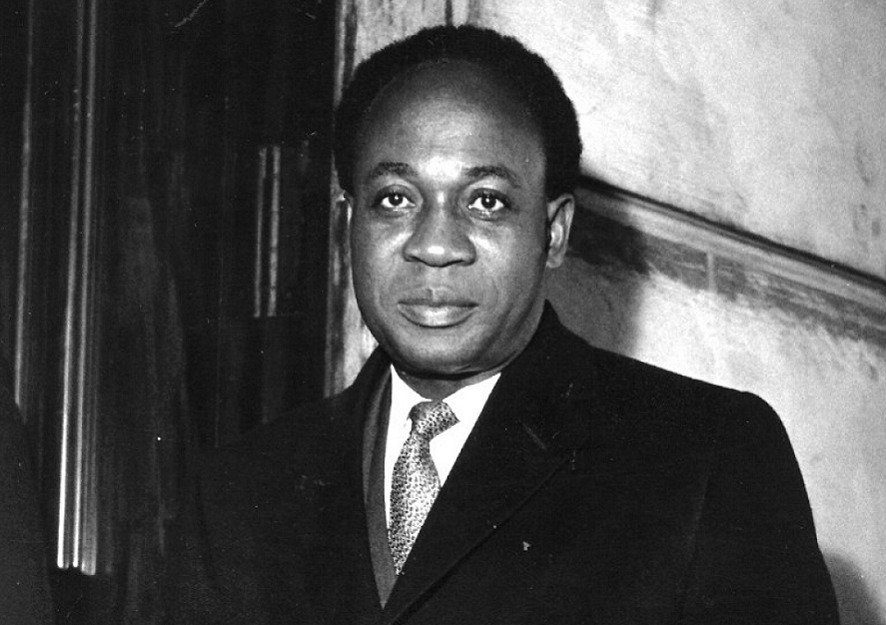
Kwame Nkrumah

… No talking drum announced this tragedy to his own people in mournful tones. No gong-gong summoned any familiar face to his side. No dirges recounted a litany to his praise. No linguist was present to recite any of his numerous appellations in eloquent and ornate language. Ironically, “Osagyefo,” “Kwame Atoapem,” “Show Boy” lay cold and still in a lonely infirmary among a strange people he did not know. His own people had rejected him and put a price on his head as a common criminal 10. Ghana, the land which he risked everything to free from bondage, had stabbed a deadly wound in his heart. Like the stab of Brutus to Caesar, it was “the most unkindest cut of all”; for as we knew Brutus to be Caesar’s angel, so was Ghana dearest to Nkrumah’s heart. And like Caesar, struggling in excruciating pain till he fell beneath the statue of Pompey, so did Nkrumah struggle alone in the agony of death, till he gave up his weary soul to its Maker in the Bucharest infirmary. “And what a fall was there there, my countrymen, that deny you and I and all.” Ghana and Africa fell.

These were the words of Accra’s Weekly Spectator journalist Kwabena Kissi in an article titled: “Nkrumah, the Leader We Never Understood.”

The article was published following the death of Ghana’s deposed leader, 62-year-old Kwame Nkrumah, on April 27, 1972, in a hospital in Bucharest, Romania, where he was undergoing medical treatment since August 1971.

He is reported to have died of prostate cancer with no family member by his side after months of failing health following the mysterious death of his cook in Conakry, Guinea, where he was exiled after his overthrow in 1966.

The cause of his death has been an issue of contention as Nkrumah himself believed he was not safe from Western intelligence agencies and had suspicions of being poisoned.

Guinea, the country that made Nkrumah a Co-president for his immense support after French political and financial abandonment in 1958, held Nkrumah dearly after his overthrow and during his ill health.

Nkrumah’s wife, Fathia, was living in her home country Egypt with their three children after the coup that expelled them from Ghana.

His first son, Dr. Francis Nkrumah who is now a professor, visited his ailing father in Guinea intermittently from Ghana where he lectured at the University of Ghana.

The Ghana government after Nkrumah’s overthrow led by Dr. Kofi Abrefa Busia rejected pleas from Guinea between 1970 and 1971 to allow Nkrumah to return home for treatment after his ill health surfaced.

Kofi Abrefa Busia

In January 1972, the government was overthrown by Colonel Ignatius Kutu Acheampong of the National Redemption Council (NRC) who adopted a pro-Nkrumahist stance of Pan-Africanism. Three months after the coup, Nkrumah died after efforts to bring him to Ghana proved futile due to the seriousness of his illness.

Guinea, in turn, refused to return the body of its Co-president, until some demands were met. Sekou Toure vowed to send the body to Ghana for the dignified burial promised by the coup leader only after his demands were met.

According to reports at the time, the demands included the lifting of all charges pending against Nkrumah, release of all Nkrumah supporters from prison, removal of threats against Nkrumah’s followers who remained with him in exile and an official welcome of Nkrumah’s remains with all the honours due a deceased president, among other demands.

Colonel Acheampong who had just assumed the position of leadership of the country refused to negotiate on those terms and continued to demand the return of the body.
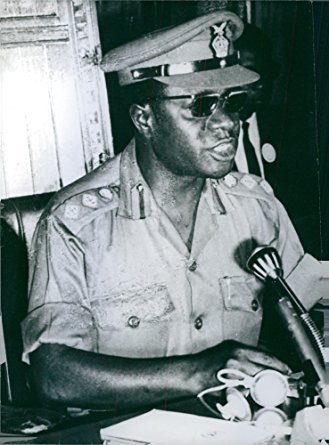
Colonel Ignatius Kutu Acheampong

It is reported that the Ghana police had offered a reward of $120,000 to anyone who brought Nkrumah back to Ghana, dead or alive. The NRC claimed that the reward was posted before they took over the country. They added that they had revoked it “in the spirit of the January 13 Revolution”. West Africa (London) May 12, 1972, p. 575.

Nkrumah’s family including his aged mother Elizabeth Nyaniba pleaded with Sekou Toure to return the body of Nkrumah.

According to a paper published in the American Universities Field Staff Reports – West Africa Series in 1972 by Victor D. Du Bois and titled The Death of Kwame Nkrumah, Toure had imposed even more impossible conditions such as the placing of Nkrumah’s tomb in front of Ghana’s Parliament building and the restoration of Nkrumah’s appointees to their former positions.

It took the pleas from Presidents William Tolbert of Liberia, Siaka Stevens of Sierra Leone, and General Yakubu Gowon of Nigeria to persuade Toure to return the body, but not until a state funeral in Guinea.

Thousands of Guineans lined the eight-mile route from the airport to the center of Conakry on Saturday, April 29, 1972, when Nkrumah’s body arrived from Bucharest. The body was driven to the state house and laid in state.

Nkrumah’s wife, Fathia Nkrumah arrived in Conakry the next day with their three children and went to the state house where they saw Nkrumah for the first time since 1966.
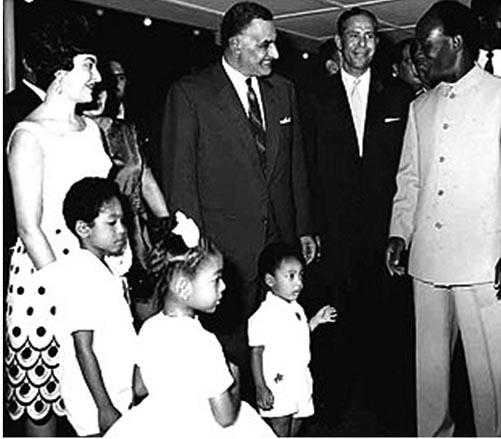
Nkrumah family had three children: Gamal (born 1959), Samia Yaaba (born 1960) and Sekou Nkrumah (born 1963).

The state funeral was held on Monday, May 1, 1972, and in attendance were African and world leaders including Cuban Prime Minister, Fidel Castro, President of Mauritania and Acting Organization of African Unity (OAU) President Mokhtar Ould Daddah, President of Liberia William Tolbert and representatives from Congo-Brazzaville, Sierra Leone, Dahomey, Tanzania and Algeria.

“Betrayed in Ghana, he found himself once again on free soil in Guinea, co-President of the Republic, to the great surprise of the imperialist powers enclosed in a bourgeois legalism. With Nkrumah, African unity became an irresistible force. That is why this thinker and this man of action is not a Ghanaian, but an African – and even more – just a man,” said Sekou Toure during his hour and a half speech at the funeral.

Later in the day, a five-member delegation from Ghana, headed by Colonel Benni, a member of the National Redemption Council, arrived in Conakry to attempt to persuade Touré to return Nkrumah’s body which had been buried.

Back in Ghana, the military government declared May 19 as a National Day of Mourning and a public holiday. A non-denominational service was held at the forecourt of the State House in Accra without the body. It was attended by members of the government, diplomatic corps and Nkrumah’s supporters.

The embalmed body of Kwame Nkrumah was exhumed and finally flown to Ghana on July 7, 1972, in a special Guinean Air Force plane after months of negotiation. All flags were ordered to fly at half-mast until the country’s first leader was buried.

Nkrumah’s body was laid in state the following day, Saturday, at the State House in Accra and thousands of Ghanaians paid their last respects. The body was flown on Sunday to his hometown, Nkroful, where he was buried in a vault.

After 20 years of his death, Nkrumah’s body was again exhumed on July 1, 1992, and reburied at a mausoleum in Accra built on the same grounds where he declared Ghana’s liberation on March 6, 1957.

This article by Ismail Akwei was first published on face2faceafrica.com
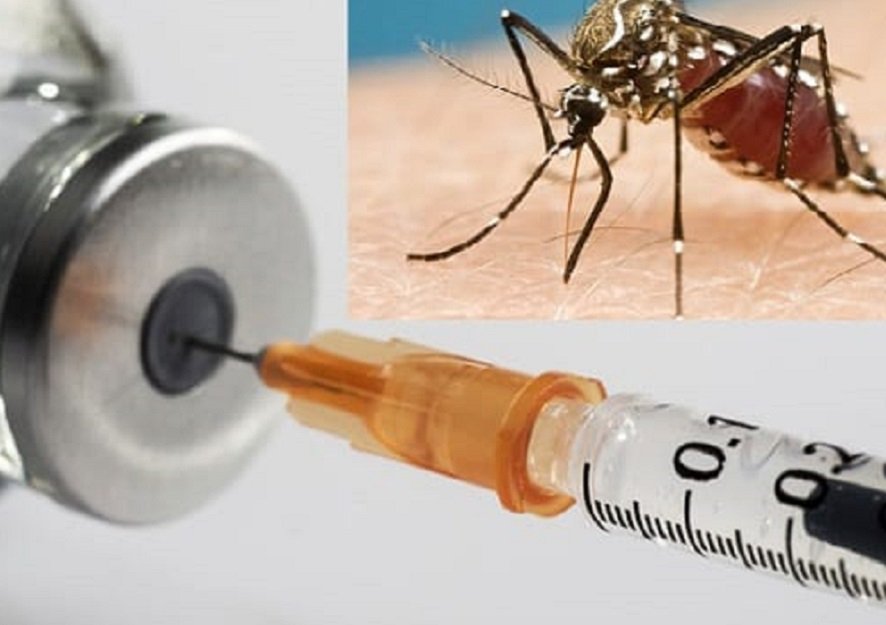
African children subjects of trial for new malaria vaccines

Photo Credit: Health Live

Trial of the world’s first malaria vaccines has been launched in Malawi as part of a large-scale pilot project run by the World Health Organization (WHO) to give partial protection against the disease.

360,000 children are expected to take the injectable vaccines within a year after the pilot is also rolled out in Ghana and Kenya where children aged between 5 and 17 months would be injected.

The WHO said health ministries in these countries decide where the vaccines would be used.

The RTS,S vaccine which prevented approximately four in 10 malaria cases during clinical trials train the immune system to attack the malaria parasite which is spread by mosquito bites, says the WHO.

“We need new solutions to get the malaria response back on track, and this vaccine gives us a promising tool to get there. The malaria vaccine has the potential to save tens of thousands of children’s lives,” said the WHO Director-General Dr. Tedros Adhanom Ghebreyesus.

The WHO said in 2018 – when the pilot programme was announced – that Ghana, Malawi, and Kenya were chosen for the pilot programme because they have continued to record a high number of malaria cases despite extensive, well-run antimalaria programmes.

The vaccine would be administered four times: once a month for three months and then a fourth dose 18 months later.

Also known as Mosquirix, the vaccine was created by scientists at the British pharmaceutical giant GSK in 1987. It has undergone years of testing and was supported by numerous organizations including PATH, a non-profit organization.

The pilot is funded by Gavi; the Vaccine Alliance; the Global Fund to Fight AIDS, Tuberculosis and Malaria; Unitaid; the WHO; and GSK.

Global efforts in the fight against malaria led to a 62 percent decrease in deaths between 2000 and 2015, but the disease still affects more than 200 million people every year, killing nearly half a million, most of them children.

The WHO said the vaccine would be used in addition to insecticides and mosquito nets which are currently the two major methods of prevention with limited impact.

Other measures have been taken to curb malaria with the most recent being in September 2018 when the Burkina Faso government announced that it has given the greenlight for the release of genetically engineered mosquitoes into the Burkinabe village of Bana.

The programme was part of Target Malaria, which is being spearheaded by the Bill and Melinda Gates Foundation. It was also an effort to use bioengineering to eradicate the spread of malaria by decreasing the number of the disease-spreading insects.

About 10,000 mosquitoes were expected to be set out into the atmosphere and they were mostly male. They are sterile and if they happen to bite, they will not release any genetically manipulated material, reports Scientific Research.

This article by Ismail Akwei was first published on face2faceafrica.com

Meet the creators of Living With Strangers, NYC-based web series that’s challenging stereotypes

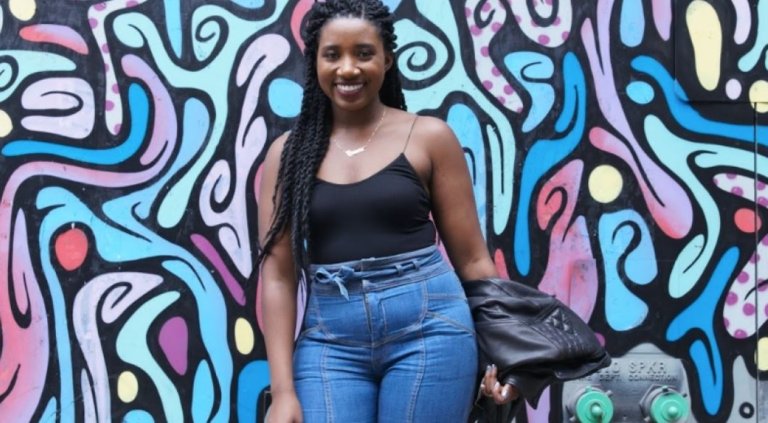
Tracy Akua Agyeiwah Ofosuhene and Carissa Lee Pinckney, creators of Living With Strangers comedy web series.

New York City is the ultimate melting point of diverse cultures, races, religions and ethnicities of the world. The Big Apple has hosted millions of people from around the world for over a century.

The challenges and experiences of living in the multi-cultural city inspired the creation of the comedy web series Living With Strangers which was released on Thursday, April 18, 2019.

Created by New York-based African-American filmmakers, Tracy Akua Agyeiwah Ofosuhene and Carissa Lee Pinckney, the show highlights various issues through five characters of diverse backgrounds who don’t know each other but decided to share an apartment in the city.

The lead characters

Casey the free-spirit, Lynn the “bitch next door”, Roger the lazy stoner, Nick the fashion-forward metro and Nancy the awkward-as-f#$k aspiring film director attempt to navigate life in New York as they struggle to learn to get along by testing each other’s limits and challenging the vastly inaccurate views of society today.

To better understand the serialized comedy, Face2Face Africa reached out to the co-creators Tracy Akua Agyeiwah Ofosuhene and Carissa Lee Pinckney to explore their journeys and the story behind Living With Strangers.

College pulled the 29-year-olds to New York City where they both gained a Bachelor of Fine Arts (BFA) degree from New York University’s Tisch School of the Arts.

Tracy Akua Agyeiwah Ofosuhene

“College forced me, and Carissa, to live with people we didn’t know and I grew from that because it had me go outside my comfort zone, make friends outside my usual typical social circles, and really helped me grow as a person,” said Tracy who is the brainchild of Living With Strangers and grew up in Northern Virginia near Washington DC.

“Once I left my tiny city for the gargantuan city of New York, I finally started to understand myself and really felt like I had found a community of like-minded people to create with and to share my experiences with. After NYU, I moved to LA to continue acting and really to throw myself in the fire and be reborn of sorts,” said Carissa who grew up in High Point, North Carolina.

Tracy is a first-generation Ghanaian-American who has visited Ghana twice and experienced the West African country’s rich cultures and diversity. “Visiting Ghana was AMAZING! I went for my grandmother’s 90th birthday with my mother and got to see how rich Ghana is when it comes to life and culture.

“I went to this awesome outdoors dance club and was excited to see all these young people from all over the world: Germany, Canada, Italy, Hong Kong, France, South America, India. I think a lot were study-abroad students, but still, it was amazing to see such diversity…to see people from around the world visiting Ghana to take in its rich culture,” she told Face2Face Africa.

Tracy’s background has also influenced her work which Carissa – who plans on visiting the continent for the first time – believes is an important addition to the Living With Strangers story.

“My connection to the continent is somewhat faint but my connection to the diaspora is constant and strong. I have spent a great deal of time exploring my connections to Black people all over the world, constantly finding more and more connections.

“Tracy being of direct African descent has made working with her eye-opening and the series that we work on more well-rounded. We have such different views on a similar experience. We are then able to talk through those differences and add them to the backbone of our story arches,” explains Carissa.

Carissa Lee Pinckney

Carissa, who had wanted to become a doctor until age 16, was introduced to the Living With Strangers idea two years ago while she was acting in LA. Her interest in being behind the scene grew after reading the first draft which made her “excited to see characters that looked more like people I know.”

“I came on later because I thought the idea was great and more importantly the characters were whole and they had a lot to say about our society by merely existing. Plus it was funny and who doesn’t like to laugh? Each character felt like it was lifted from my New York life,” she said.

For Tracy, she had an interest in filmmaking since high school when she was a producer for a school news show after failing at anchoring. Living With Strangers was a way for her to “add to the conversation about representation in the media and allowing people who are underrepresented i.e. women, people of color, LGBTQ+, and more to be seen as multidimensional multifaced characters.”

“We created a funny show that is relatable and authentic. We told stories based on our own experiences about a time in our lives when we were young, dumb, and reckless. It’s a time period everyone has gone through which makes it very VERY universal and exactly why it’s so relatable and authentic,” she added.

Living With Strangers has received a lot of positive feedback since the official trailer of Part 1 was released over a month ago. Tracy is looking forward to working on Part 2 as well as another project headed by Carissa which will focus on her interracial marriage.

Tracy Akua Agyeiwah Ofosuhene has worked on films and tv shows including American Idol, East Los High, Spin, Next of Kin, Call to the Pen, Eighth Grade, and Creed II.

Carissa Lee Pinckney has also been an actor since 2010 and has been cast in productions including Aleshea Harris’ “What to Send Up When It Goes Down” at Boston Court and at A.C.T in San Fransisco, and the opera “Iceland” at Ford Amphitheater. She has also written, directed, and starred in her own one-act show entitled “The Belt Titans” which highlighted her personal experiences growing up in North Carolina.

This article by Ismail Akwei was first published on face2faceafrica.com

Africans startled by European identity of the continent’s biggest online marketplace

Jumia staff celebrating their NYSE listing. Bell rang by Jumia Nigeria CEO Juliet Anammah.

Recently listed on the New York Stock Exchange (NYSE) and considered to be Africa’s first startup to achieve that feat, e-commerce platform Jumia has been slammed by Africans for having two French top executives, headquarters in Germany and Dubai and developers in Portugal.

Its CEO, Sacha Poignonnec, incurred the wrath of many others during an interview on CNBC where he explained why the company’s technical talents were Europeans. “The reality is, in Africa there is not enough developers… We know that and we need to collectively address that because everything should be in Africa.”

His statement generated the hashtag #JumiaIsNotAfrican to take away the Africa tag associated with the company which was co-founded in 2012 and valued at more than $1 billion.

Many Africans have expressed serious reservations on social media against Jumia’s identity and seeming exploitation of the African market to promote their European agenda.

“Some of us are getting riled up about Jumia being considered to be African. It’s not for nothing. This colonial type business model is not new. Jumia is the modern day CFAO,” tweeted Cameroonian tech entrepreneur Rebecca Enonchong.

“My standard for saying a startup is African is simple: the idea originates from Africa and it is founded by an African,” Nigerian tech veteran and investor, Victor Asemota, told Quartz Africa.

He also lamented about the use of African affiliation as a prop by some foreign companies. “Their real ambition is to gain quick recognition,” he is quoted as saying.

Jumia operates in 14 countries including Nigeria, Kenya, Ghana, Algeria, Angola, and Senegal where its offices are occupied by local staff and country heads.

Co-founders Sacha Poignonnec and Jeremy Hodara, two former employees of McKinsey, opened their first shop in Nigeria in 2012 alongside Nigerian Tunde Kehinde and Ghanaian Raphael Kofi Afaedor who both left the company in 2015.

Here are some reactions to Jumia’s European identity by Africans who believe that a company cannot be African because its primary market is the continent

Reaction needs an action… boycott their platform or products unless they have 60 % of employees in Africa.

— Jean Njoroge PhD (@shirojean) April 15, 2019

So Jumia scammed our minds to believe that it was ours, which was the only reason why we trusted them enough to support them. Sad

— G (@geesus_x) April 14, 2019

What needs to be done for Afrika needs to be done by afrikaans. Jumia is like the white colonial settlers who while partitioning afrika amongst themselves during dinner parties understood its potential, but unwilling to give its people any legitimate share of their(our*) profit.

— Najma_ (@najmagulled) April 15, 2019

This article by Ismail Akwei was first published on face2faceafrica.com

Remembering three-time Grammy nominee Hugh Masekela and the life he lived

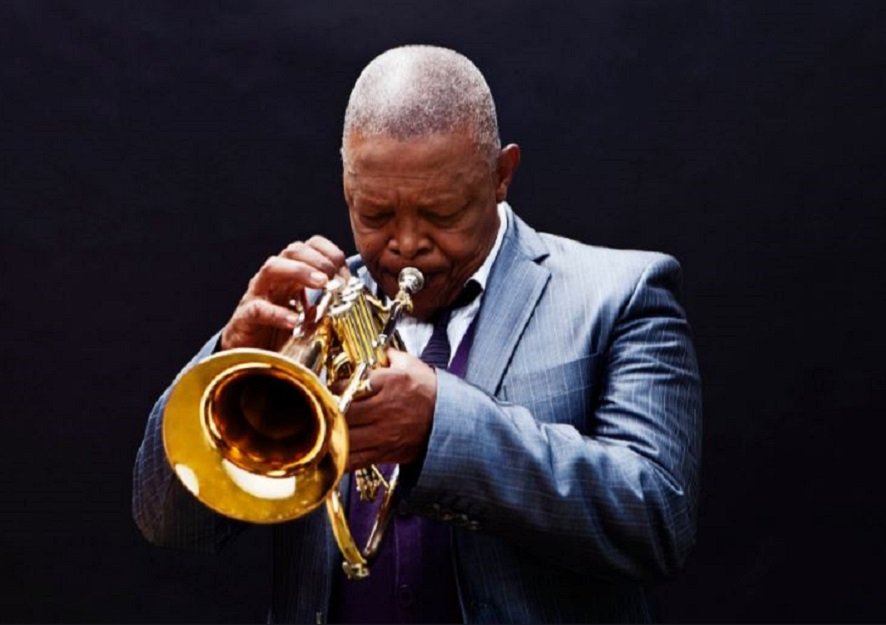
Legendary South African Jazz Musician Hugh Masekela who died on January 23, 2018.

The “Father of South African Jazz” and Africa’s musical luminary Hugh Masekela has left a big hole in Africa’s heart after his passing on Tuesday, January 23, 2018, in Johannesburg at the age of 78.

Hugh Masekela lost a long battle with prostate cancer which was discovered 2008 and spread to other parts of his body. Despite the disease, the world-renowned flugelhornist, trumpeter, bandleader, composer, singer and political activist continued to perform until his death.

We take you through the journey of his rich life as we mourn this illustrious son of Africa.

Early Life

He was born Hugh Ramapolo Masekela on April 4, 1939, in Witbank, South Africa to a health inspector father and social worker mother. Hugh was largely raised by his grandmother who ran an illegal bar for miners.

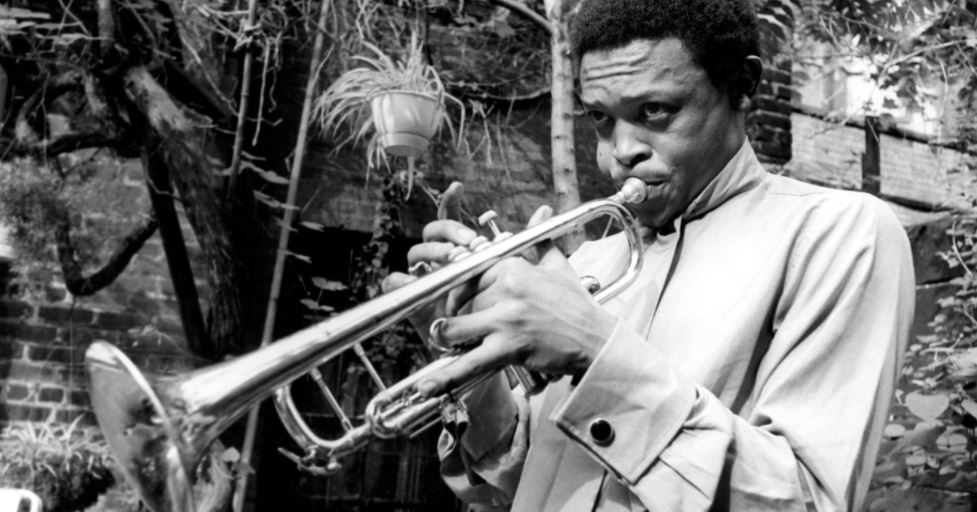
He fell in love with singing and playing the piano until he was 14 when he took hold of a trumpet after seeing the film Young Man with a Horn (in which Kirk Douglas plays a character modelled on American jazz cornetist Bix Beiderbecke).

His first trumpet belonged to Louis Armstrong and it was given to him by Archbishop Trevor Huddleston, an anti-apartheid chaplain at St. Peter’s Secondary School now known as St. Martin’s School (Rosettenville).

Masekela mastered the trumpet after tutorial from the leader of the then Johannesburg “Native” Municipal Brass Band, Uncle Sauda, who taught him the rudiments of the instrument. With other schoolmates, Masekela joined the newly formed Huddleston Jazz Band, South Africa’s first youth orchestra.

He portrayed his struggles and feelings towards the apartheid regime in his music and by 1956, Masekela joined Alfred Herbert’s African Jazz Revue. After the Manhattan Brothers tour of South Africa in 1958, Masekela joined the orchestra of South Africa’s first successful musical King Kong, written by Todd Matshikiza.

The musical was a hit and they toured the country and later London before he joined Dollar BrandKippie Moeketsi, Makhaya Ntshoko, Johnny Gertze to form the Jazz Epistles in 1959. They became the first African jazz group to record an LP.

Three decades outside South Africa

The Jazz Epistles made waves in South Africa through to 1960 when 21 years old Masekela left for England after an increase in apartheid brutality. With the help of Trevor Huddleston and other friends, he was admitted into London’s Guildhall School of Music and later moved to the United States where he studied classical trumpet at the Manhattan School of Music in New York. He married Miriam Makeba in 1964 and they divorced two years later.

Hugh Masekela spent 30 years outside South Africa and he flourished on the world scene after deriving inspiration from jazz greats like Miles Davis, John Coltrane, Thelonious Monk, Charlie Mingus and Max Roach.

He also got some training from Dizzy Gillespie and Louis Armstrong who encouraged him to develop his own unique style from his African influences. He recorded some hit songs after his debut album Trumpet Africaine released in 1963.

Big break

Masekela moved to Los Angeles and hanged out with icons like David Crosby, Peter Fonda and Dennis Hopper. After a performance at the 1967 Monterey Pop Festival alongside Janis Joplin, Otis Redding, Ravi Shankar, The Who and Jimi Hendrix, his 1968 single ‘Grazin’ in the Grass’ went to Number One on the American pop charts and elevated him onto the international stage.

He released over 40 albums in his five decades solo career and has recorded with artists such as Harry Belafonte, Dizzy Gillespie, The Byrds, Fela Kuti, Marvin Gaye, Herb Alpert, Paul Simon, Stevie Wonder and the late Miriam Makeba.

Miriam Makeba and Bra Hugh Masekela duet on Soweto Blues #RIPBraHughMasikela pic.twitter.com/et0W5ieEyV

— SA TRENDS 20K ⭕ (@princematyeka) January 23, 2018

Some of his hit jazz tunes include “Up, Up and Away” (1967), “Don’t Go Lose It Baby” (1984) and “Bring Him Back Home” (1987) which was popularly known as the anthem for anti-apartheid movement and the movement to free Nelson Mandela.

African connection

Hugh Masekela moved around Africa from 1974 when he organised the Zaire 74 music festival in Kinshasa with his friend Stewart Levine for the Rumble in the Jungle boxing match. He worked with some West and Central Africans before setting up a mobile studio in Botswana from 1980 to 1984 with the help of Jive Records to reconnect with Southern African musicians.

He later founded the Botswana International School of Music (BISM) in Gaborone in 1985, which holds annual music workshops to date.

Return home

In 1990, Hugh Masekela finally returned home to South Africa after the release of Nelson Mandela and the overthrow of the apartheid regime.

In 2003, he was featured in the documentary film Amandla!: A Revolution in Four-Part Harmony. A year later, he published his autobiography, Still Grazing: The Musical Journey of Hugh Masekela (co-authored with D. Michael Cheers).

His life story continued with album releases, concerts and a feature in a series of videos on ESPN in 2010 with his son Selema “Sal” Masekela who is an American television host, sports commentator, actor, and singer born in 1971.

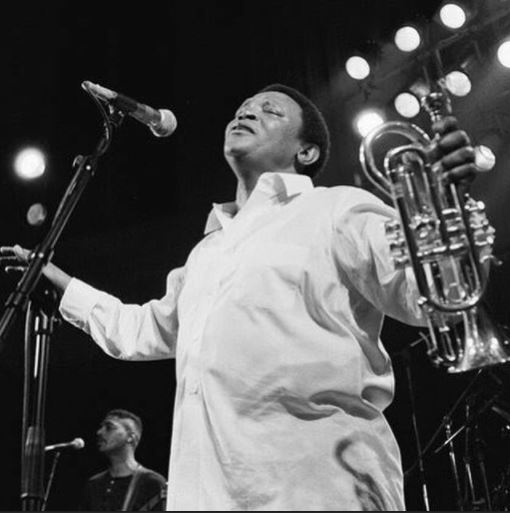
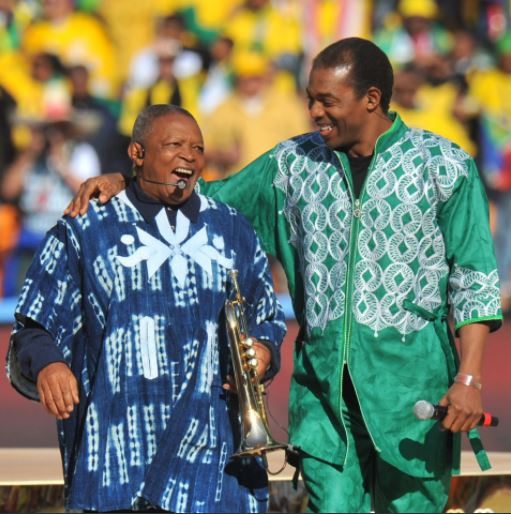
Hugh Masekela opened the South Africa 2010 FIFA World Cup Kick-Off Concert and the event’s Opening Ceremony in Soweto’s Soccer City.

Awards & Honours

South African president Jacob Zuma honoured Masekela with the highest order in South Africa: The Order of Ikhamanga in 2010. He also received a Lifetime Achievement award at the WOMEX World Music Expo in Copenhagen in 2011. The US Virgin Islands proclaimed ‘Hugh Masekela Day’ in March 2011.

Besides the many awards Masekela has won, he has been nominated three times for a Grammy Award including a nomination for Best World Music Album for his 2012 album JabulaniBest Musical Cast Show Album for Sarafina! The Music Of Liberation (1989) and Best Contemporary Pop Performance for “Grazin’ in the Grass” (1968).

He has received many honours including the Doctor of Music (honoris causa) from the Rhodes University in 2015 and an Honorary Doctorate in Music from the University of York in 2014.

This article by Ismail Akwei was first published on face2faceafrica.com