We always hear about satellites being launched into space but hardly hear about African satellites.
This is not the case anymore as South Africa’s first privately owned nanosatellite – nSight1 – was successfully launched into orbit from the International Space Station last week.
This was followed by Ghana’s first satellite called GhanaSat1. It was developed by university students who took two years to design, assemble and test as part of a Japanese space project.
Watch this edition of Hi-Tech on The Morning Call with Ismail Akwei.
This article was first published by Ismail Akwei on africanews.com.
In November last year on the Hi-Tech segment, we talked about some polytechnic students in Ghana’s second-largest city of Kumasi, who technologically altered car engines to run on electricity.
In June, we broke the story about a Ghanaian university’s launch of the country’s first satellite into space.
The technological achievements didn’t end there.
Last week, the Kwame Nkrumah University of Science and Technology in Kumasi, unveiled a solar-powered electric 4×4 pick-up vehicle known as “aCar”.
It was inaugurated by its Chancellor and King of the Ashanti Kingdom, Otumfuo Osei Tutu II who gave the environmentally friendly automobile a test drive during the university’s congregation.
It was jointly developed by the university’s Departments of Mechanical Engineering and Physics, in partnership with the Technical University of Munich in Germany.
According to the Vice-Chancellor, Professor Kwasi Obiri-Danso, the prototype was developed as part of a project to explore the mobility needs of the country.
He said the aCar is a response to local needs, using affordable, environmentally friendly and locally available materials.
The vehicle is still being tested and fine-tuned to bring it up to standard. Other dignitaries at the university’s congregation were taken through the vehicle’s system that combines electric power with solar energy.
The Kwame Nkrumah University of Science and Technology has other inventions including an open-space fire detector, solar-powered traffic lights and drones to support the nation’s development process.
Ghana’s radio astronomy success
Ghana and South Africa have announced the successful conversion of a communications antenna into a functioning radio telescope linking the two countries.
The conversion of Ghana’s redundant 32-meter telecommunications antenna at the Ghana Satellite Earth Station at Kuntunse, in the Greater Accra Region into an astronomical radio telescope, makes the country the first in Africa among nine others to do so.
The upgrade project started in 2011 in collaboration with South Africa to create the African astronomical radio network as an extension of the global network.
The new astronomical radio telescope has already made some important observations.
This is the first phase of the project. The second phase will be the integration of the network to the African network and then across the continent.
A seven-member Ghanaian team has undergone training in South Africa and has been trained in all aspects of the project, including the operation of the telescope.
Watch this edition of Hi-Tech on The Morning Call with Ismail Akwei.
This article was first published by Ismail Akwei on africanews.com
Zimbabwean police have cautioned unsuspecting men and the general public to be wary of a group of women accused of sexually assaulting men in the capital Harare.
Two separate incidents were reported last week after an August last year incident when four women drugged and “sexually molested” a 29-year-old man they had offered a lift.
Police spokesperson Chief Superintendent Paul Nyathi told local media The Herald that the first incident occured last Saturday when a 37-year-old man boarded a bus with two female passengers and a male driver.
He explained that another female passenger joined the bus before the driver later changed his route to “evade a police roadblock”.
“On the way, one of the females who had boarded the vehicle together with the complainant, drew what appeared to be a pistol and force-marched the complainant into a bushy area along Delport Road,” The Herald quoted the police spokesman.
“One of the females forced the complainant to have sexual intercourse with him without his consent while another female accused forced the complainant to drink an unknown liquid which left the complainant unconscious,” he said.
Chief Superintendent Nyathi also narrated the ordeal of the second victim who was given a lift to Harare by five women. He was offered a drink which left him unconscious.
“When the complainant gained consciousness he discovered that he had been abused,” he said.
He urged the public with information to assist the police with their investigation.
“We would like to urge members of the public to be on the lookout for a group of men and women who are giving unsuspecting victims transport and end up abusing them,” Chief Superintendent Nyathi advised.
Similar incidents also spiraled in September 2015 when two women allegedly raped a man at gunpoint after offering him a lift, The Herald reports.
This article was first published by Ismail Akwei on africanews.com.
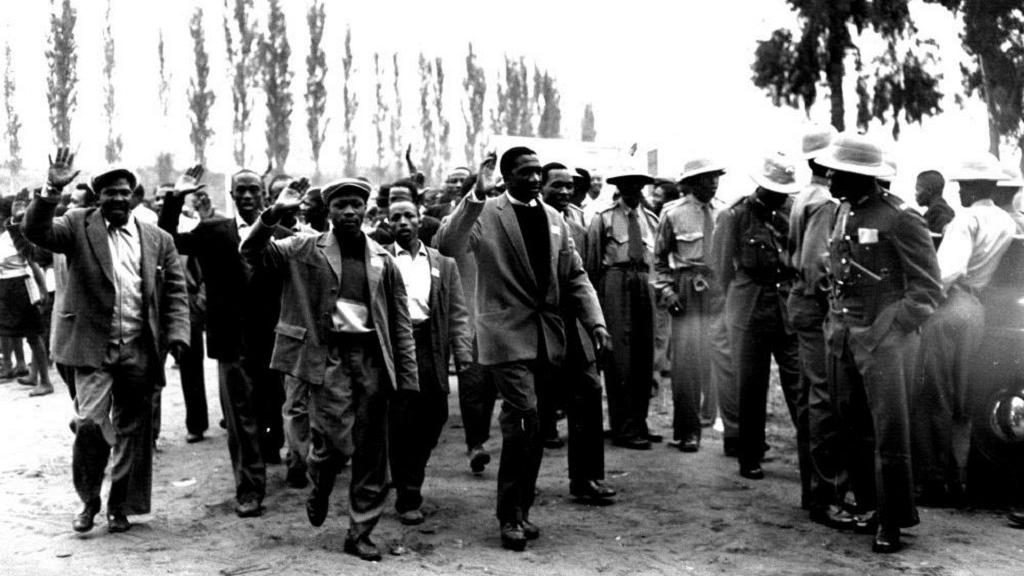
On Monday, March 21, 1960, after a decision to embark on a peaceful protest to denounce pass laws designed to segregate South Africans, 300 armed policemen opened fire at over 5000 protesters at the Sharpeville police station killing 69 on the spot.
The protest was organised by the African National Congress (ANC) breakaway group, Pan Africanist Congress (PAC) who called on South Africans to leave their passes at home and march peacefully to police stations nationwide to be arrested.
The protest was peaceful at other police stations where no arrests were made; but the Sharpeville Massacre that resulted in 180 injuries changed the face of the apartheid era as subsequent protests erupted and more deaths recorded.
As we remember the Sharpeville and Langa Massacres, we must appreciate and respect the experiences and pain of black people.
The United Nations in 1966 proclaimed the day as the International Day for the Elimination of Racial Discrimination and South Africa marks the day as Human Rights Day.
On Tuesday, March 21, 2017, a free South Africa led by President Jacob Zuma is commemorating the day by honouring anti-apartheid activist and Black Consciousness Movement leader Steve Biko who was murdered 40 years ago at the age of 30.
President Zuma laying a wreath on a tomb of the Black Consciousness leader Bantu Steve Biko, Eastern Cape pic.twitter.com/lvwE7LzYhl
— Presidency | South Africa 🇿🇦 (@PresidencyZA) March 21, 2017
Wreaths were laid at the Phelindaba Cemetery in Sharpeville, Gauteng where the victims of the massacre were buried, and at the monument next to the police station where they were shot.
It is climaxed with a 2km anti-racism and anti-xenophobia walk from the monument to George Thabe Stadium.
The United Nations is also marking the day under the theme: Racial profiling and incitement to hatred, including in the context of migration.
The United Nations has called on the Eritrean government to release journalist, playwright and writer Dawit Isaak who was jailed since 2001 during a political crackdown.
The 2017 UNESCO/Guillermo Cano World Press Freedom Prize winner was last sighted in 2005 since his arrest and his whereabouts are unknown.
“The case of Mr. Isaak is emblematic of all those who have been subjected to enforced disappearances by the Government of Eritrea and remain unaccounted for,” Special Rapporteur of the UN High Commissioner for Human Rights on Eritrea, Sheila B. Keetharuth said in a statement on Wednesday.
“The Government of Eritrea has an obligation to urgently provide information on the fate and whereabouts of all those deprived of physical liberty,” she said while calling on the Asmara authorities to release unconditionally Isaak and all others detained unlawfully.
52-year-old Dawit Isaak is one of the founders of the first independent newspaper in Eritrea – Setit – after his return to the country after independence in 1993.
He is a citizen of Sweden, where he lived since 1987.
On September 23, 2001, Isaak was arrested in his Asmara home and jailed together with other independent journalists of the so-called G-15 group that demanded democratic reforms in a series of letters to the then President Isayas Afeworki.
“The arrests of Dawit Isaak and his fellow journalists remain the most visible sign of repression of freedom of expression. The Eritrean authorities continue to stifle all forms of expression that could be perceived as critical of the Government and its policies,” Sheila B. Keetharuth said.
There have been numerous rumours of Dawit Isaak’s death since he was arrested.
On the occasion of this year’s World Press Freedom Day, the United Nations Secretary-General, Antonio Guterres has called for an end to the crackdown on journalists who he described as a “voice of the voiceless.”
The international day was proclaimed by the UN General Assembly in 1993 following a Recommendation adopted at the 26th Session of UNESCO’s General Conference in 1991.
This article was first published by Ismail Akwei on africanews.com.


 Ismail Akwei