After many years of being referred to as Indonesian, social networking site Twitter has finally recognized Swahili as a language and offers a translation of the popular East and Southern African language.
Hi @MariaSTsehai, we’re so inspired by de many #Kiswahili speakers who tweet in their language. Now, more than ever, they can do so without worrying that de world will not “hear” them. @Twitter has finally heard us… de first native African language is now properly indexed here pic.twitter.com/QoriWyOeZD
— African Languages Day (@AfriLanguages) May 6, 2018
Since last week, Twitter began detecting the language in tweets and offers a close to perfect translation. The news has excited many speakers including the Kenyan government whose country recognises the lingua as a national language.
TWITTER RECOGNISES SWAHILI AS A LANGUAGE: USA based social networking site Twitter recently added the capability to detect Swahili words in tweets & to translate them. Kiswahili which is widely used in East Africa, is Kenya's National language & it unites the people of Kenya. pic.twitter.com/TMzgWU1IXu
— Ministry Of Sports, Culture & Heritage (@moscakenya) May 7, 2018
The recognition came after years of protest by Swahili speakers using hashtags #SwahiliIsNotIndonesian and #TwitterRecognizeSwahili to drive the message through.
However, the transition has not been fully completed and some Swahili speakers on Twitter are yet to appreciate the recognition.
Swahili is spoken by over 50 million people and it serves as the national language of four nations: Tanzania, Kenya, Uganda, and DR Congo.
A fraction of the Bantu language has its vocabulary derived from Arabic as a result of contact with Arabic-speaking Muslim inhabitants.
Below are some mixed reactions to the Twitter recognition of Swahili:
Waaaaaait a minute, kumbe @Twitter launched Swahili as one of its languages, no wonder that annoying "translate from Indonesian" tag no longer appears in Swahili tweets
People are reporting that this, and of course efforts by others, has worked in that @Twitter has now recognised Swahili as official language. Thank you @jack and team. pic.twitter.com/YGpmFJJk46
People are reporting that this, and of course efforts by others, has worked in that @Twitter has now recognised Swahili as official language. Thank you @jack and team. pic.twitter.com/NtlD17EV9h
We agree. While #Swahili has finally made the cut as the first native African language, literally days ago after pressure brought to bear on @Twitter, we believe more can be done. At the least, all the top 10 most spoken languages should be properly indexed.#AfricanLanguagesDayhttps://t.co/lZDotcH3F3
— #AfricanLanguagesMatter (@AfriLanguages) May 3, 2018
This article by Ismail Akwei was first published on face2faceafrica.com
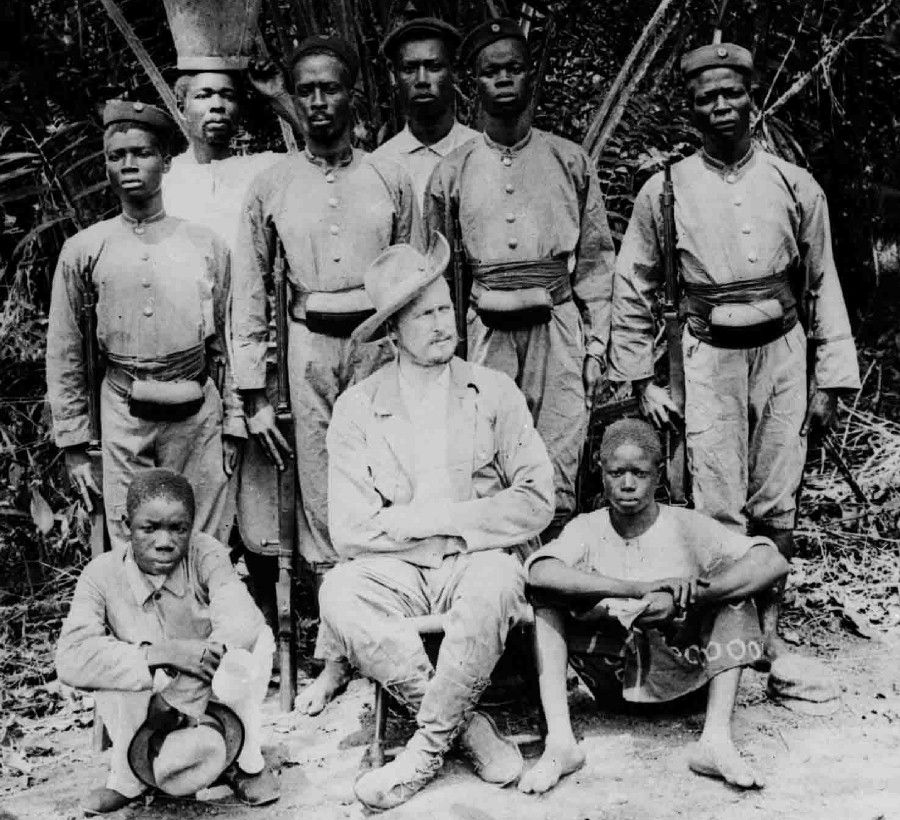
This photograph shows soldiers of the Togo Polizeitruppe with their German commander
The French-speaking West African nation of Togo was pivotal during the transatlantic slave trade as Portuguese slave traders sought the human merchandise at the small fort of Porto Seguro, in the town currently known as Agbodrafo and lying between the Atlantic Ocean and Lake Togo.
During the infamous Scramble for Africa in 1884, Germany took hold of Togo and the current Volta Region of Ghana as a protectorate collectively known as the German Togoland.
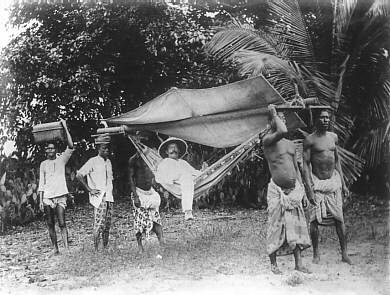
German colonial lord carried by locals
This was legalized after Gustav Nachtigal signed a treaty with the chief of Togoville, King Mlapa III in the same year.
This photograph shows soldiers of the Togo Polizeitruppe with their German commander
The protectorate became Germany’s only self-supporting colony as the locals were forced to work on cotton, cocoa and coffee plantations while paying high taxes. The Germans built the Lome port and a railway that established their rule inland.
Their occupation was short lived after the first world war defeat in 1914. The area was invaded by the British and French and in 1916, Togoland was divided into British and French zones. It was formalized in 1922 with the creation of British Togoland and French Togoland.
British Togoland after the partition
After the World War II, the territories went under the United Nations and the residents of British Togoland voted to join the Gold Coast prior to independence in 1957.
French Togoland became autonomous within the French Union in 1959 and in 1960, the Togolese Republic was proclaimed. The country held its first presidential election in 1961 making Sylvanus Olympio the first president after he garnered 100% of the vote in elections boycotted by the opposition.
Sylvanus Olympio
The Republic thereafter went through many transitions including two military coups: in 1963 and in 1967, both led by Sergeant Gnassingbe Eyadema. The second coup overthrew Nicolas Grunitzky, the elected president after the first coup.
Gnassingbé_Eyadema
Eyadema assumed the seat of president for 38 years until his death. His son, Faure Gnassingbe assumed power till date. The ruling dynasty has been mired by protests from the opposition.
This article by Ismail Akwei was first published on face2faceafrica.com
The vaDoma tribe, also known as Doma or Dema, is the only hunter-gatherer tribe in Zimbabwe living in the Kanyemba region around the basins of a tributary of the Zambezi River Valley.
They speak the Dema language and believe their ancestors emerged from a baobab tree and walked upright to hunt and gather fruits. The secluded tribe is Zimbabwe’s only non-agricultural society.
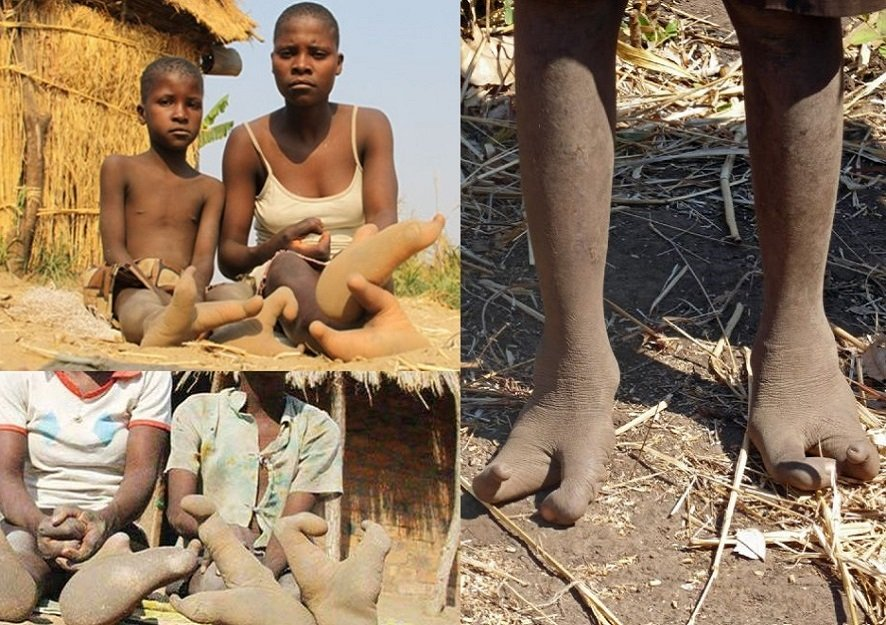
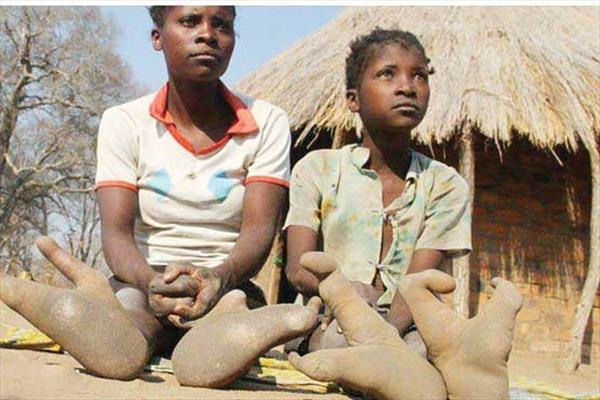
The tribe is rather famous for having the rare genetic condition known as Ectrodactyly or lobster claw syndrome. This is the absence of one or more fingers or toes at birth.
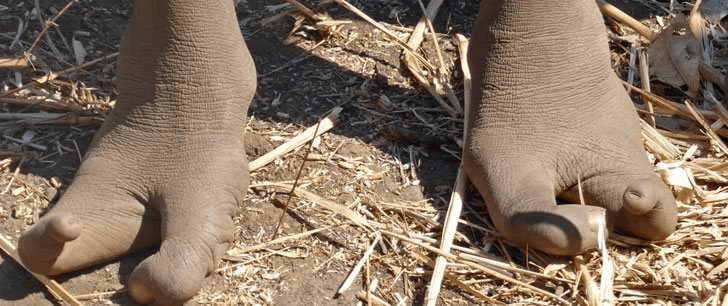
The inherited dominant genetic mutation affects only the feet of one in four children within the vaDoma population. Their middle three toes are absent and the two outer ones are turned in.
The condition resulted in the tribe being referred to as the “two-toed” or “ostrich-footed” tribe. It is against the tribal law for members to marry outside the group and as a result, the two-toed condition does not spread to other tribes.
Those with the condition are not considered disabled in the community and it is believed that their toes enable them to climb trees better.
The vaDoma people are reported to have resisted incorporation into the Korekore Shona kingdom of Mutapa prior to the European colonisation. This has cost them fertile land to grow crops.
They currently live their nomadic lifestyle in the Chewore Safari Area which has now become their mountain homeland. They are also facing threats from game rangers who are cracking down on poaching.
This article by Ismail Akwei was first published on face2faceafrica.com
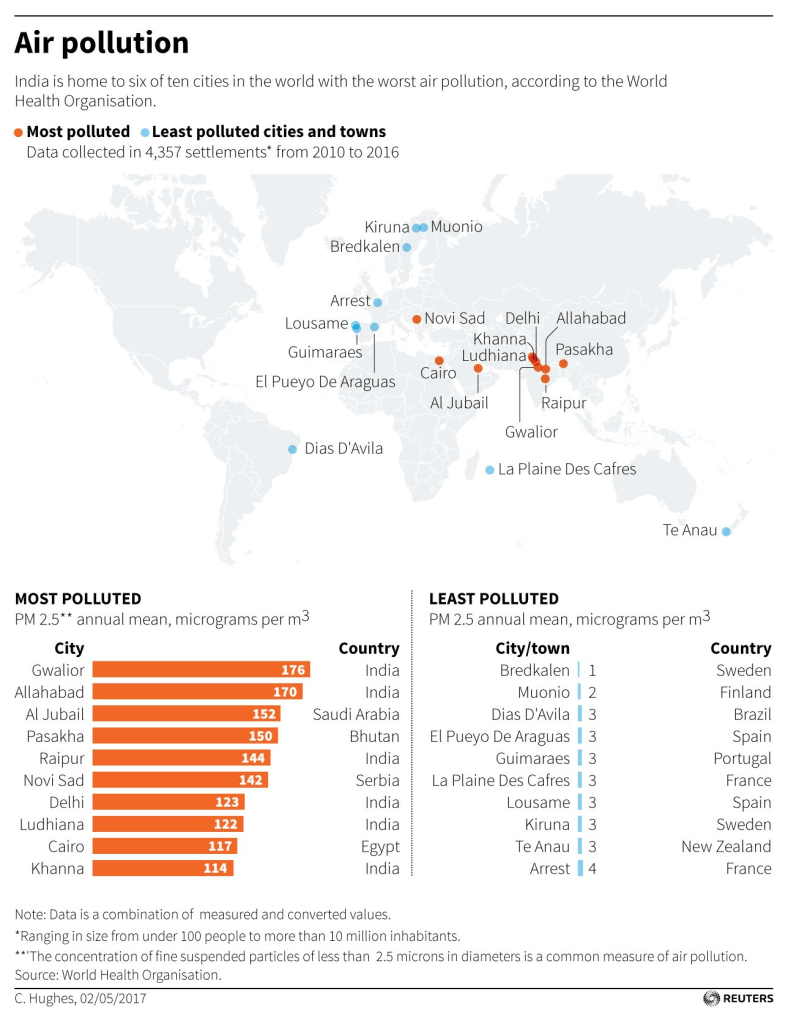
The World Health Organisation (WHO) has released a list of the world’s most polluted cities based on the amount of particulate matter under 2.5 micrograms found in every cubic meter of air.
Data was collected from 4,300 cities between 2010 and 2016 and India is home to six of ten cities in the world with the worst air pollution, according to the global health body.
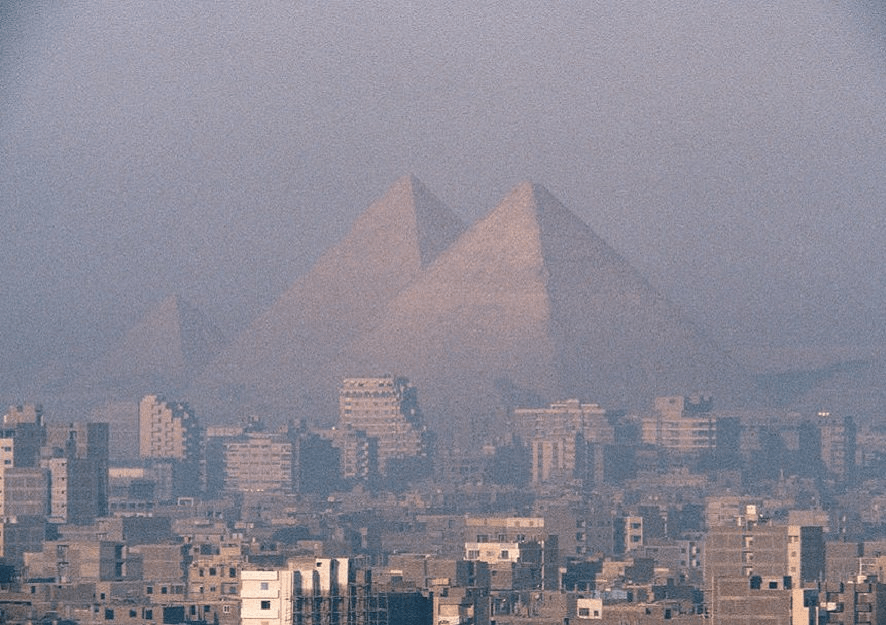
Egyptian capital, Cairo, is the only African country among the 10 most polluted cities in the world which include Delhi (India), Al Jubail (Saudi Arabia) and Novi Sad (Serbia).
Also, no African country made it on the list of the ten least polluted cities which was led by Bredkalen (Sweden), followed by Muonio (Finland) and Dias D’Avila (Brazil).
The assessment is based on satellite data and modeling overlaid on the database of cities, which is self-selecting as it is based on voluntary reporting, says WHO.
Nine out of 10 people on the planet breathe polluted air, and it kills 7 million people each year, almost all of them in poor countries in Asia and Africa. About a quarter of deaths from heart disease, stroke and lung cancer can be attributed to air pollution, WHO added.
Here is a map showing the level of air pollution in the listed countries.
This article by Ismail Akwei was first published on face2faceafrica.com
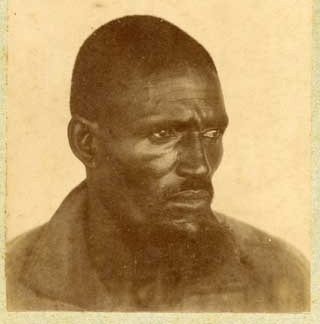
Sergeant Malamine Camara, a soldier in the French colonial army who was key in securing the Congo Basin (present-day Congo Brazzaville) for France in 1880
The world knows little about Sergeant Malamine Camara, a soldier in the French colonial army who was key in securing the Congo Basin (present-day Congo Brazzaville) for France against Belgian invasion.
Little is known about the birth and ethnicity of the young Senegalese soldier, but was believed to have been born in the 1850s to Soninke parents who were living inland Senegal.
He was recruited as part of the African colonial troops in the French army called Laptots in the 1870s. Camara volunteered in 1880 to join the expedition of Franco-Italian explorer Pierre Savorgnan de Brazza who was about to explore the Congo Basin.
From Dakar, the troop journeyed to the coast of Franceville in present-day Gabon; and then together with 11 other West African soldiers, 4 Gabonese interpreters, and 4 Frenchmen including Brazza, they crossed to the Congo River.
Camara gained the trust of the French commanders after his dedicated service and usefulness following his learning of local languages and creating an affinity with the locals.
Brazza dispatched Camara to lead a two-man team to create and man an outpost in Mfoa (present-day Brazzaville) which was on the right bank of the river. At the time, Belgium had already occupied the Democratic Republic of Congo, which was on the left bank of the river.
In the 18 months that Camara and his men had stayed in Mfoa, they had received no reinforcements or significant supplies from the French. He relied on his hunting skills to feed his men with the meat of hippopotamus and buffalo.
Camara gained the liking of the chiefs in the area after regularly offering them meat from his hunts while he defended the French flag and the territory from the Belgian rivals. He earned the names “mayele” and “tata nyama” which respectively meant a resourceful person and meat father.
He also met the leader of the Belgian colonizers of the Congo region, American Henry Morton Stanley, to claim Mfoa. In 1881, Camara visited the camp of Stanley in Kinshasa with a treaty signed by a local chief Makoko Iloo I and Brazza which granted France the territory.
Stanley crossed the river anyway in 1882 with a large number of Zanzibari mercenaries to scare away Camara and his men. They failed as the Senegalese unflinchingly held the fort.
Later that year, Camara and his men were ordered to return to Franceville in Gabon. Sensing danger, the Senegalese visited all the local chiefs and urged them to be loyal to France in his absence.
Camara returned to Dakar and in 1833, he was recalled by Brazza to recruit African soldiers and buy supplies for another expedition to the Congo basin. Upon arrival, he was hailed by the locals.
The Senegalese worked under Frenchman Brazza and later his deputy Charles de Chavannes who later claimed that the Belgians in Kinshasa had put a bounty on Camara’s head due to his importance to the French.
In 1885, Malamine Camara fell ill and was later awarded the Médaille Militaire, the third highest military honours given to non-citizens in the French armed forces.
His health was not getting better after he was diagnosed with what appears to have been a bladder infection. Camara was sent home to Senegal where he died the following year in a military hospital in Goree Island. He was about 36 years old.
Camara is reported to have never been able to collect his salary from his last mission, but has a bronze plaque dedicated to him in Brazzaville by France following his death. A steamboat was named in his honour and a street in Brazzaville was also named after him. In his country Senegal, a secondary school was renamed in his honour.
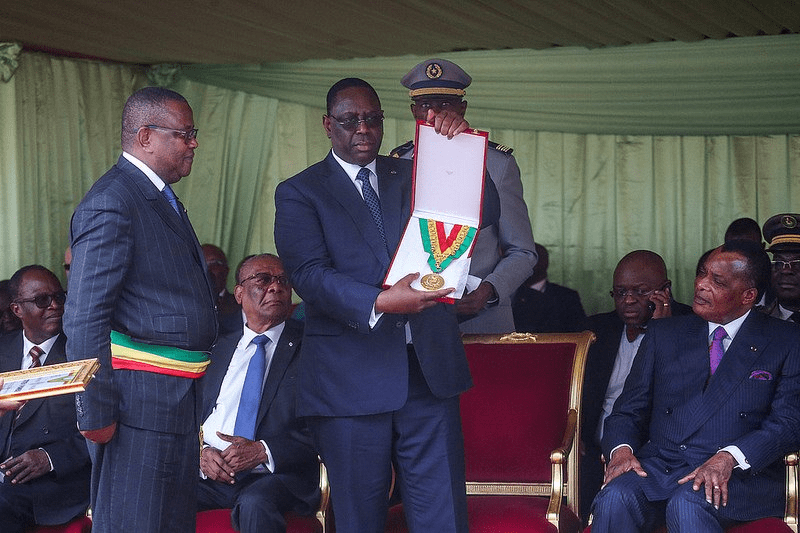
On April 29, 2018, Malamine Camara was honoured by the city of Brazzaville with posthumous citizenship, the city’s flag, a crown and a medal. They were presented to Senegalese president Macky Sall at a ceremony attended by the president of Congo Brazzaville Denis Sassou Nguesso.
Senegalese president receiving the honour on behalf of Malamine Camara
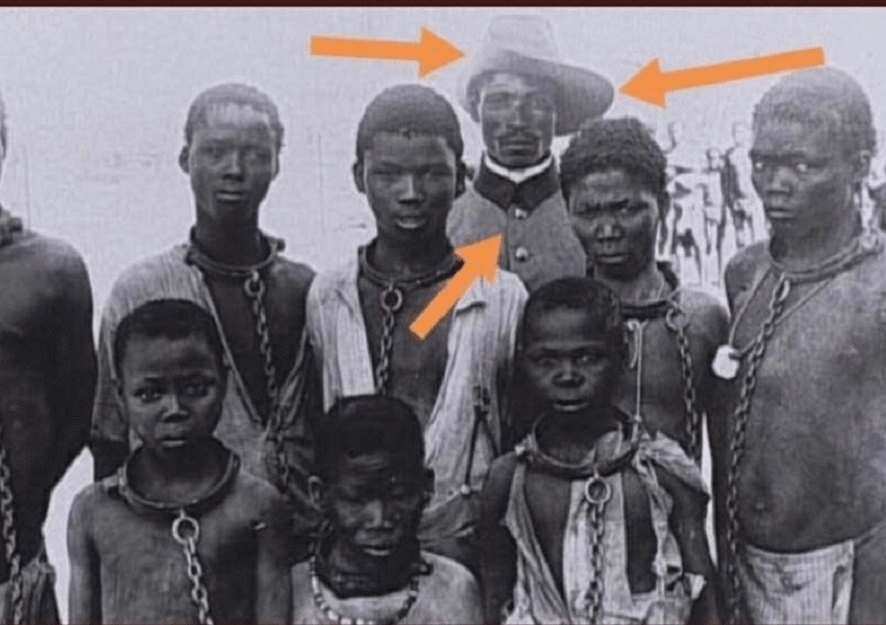
This honour was questioned by some Congolese who accused Camara of helping the French enslave locals at the time. A picture of him with shackled men and children was shared on Twitter and below are some reactions in French and their translations:
Je me demande qui écrit les discours de ce vieux dictateur sanguinaire assassin au nom de Sassou dénis ???? Voici le sergent Malamine que Papi a honoré je suis tout simplement outré et choqué 🤯 @30ansSassoufit @SBerrebi@BYC125@aya_isidorepic.twitter.com/rYZ3VALUNc
“I wonder who writes the speeches of this bloodthirsty old dictator and murderer in the name of Sassou denis???? This is the Sergeant Malamine that Papi honoured, I’m just outraged and shocked.”
La maîtrise de l'histoire… Même à l'école ce n'est pas l'image qu'on nous a donné du Sergent #MALAMINE c'est tout le contraire.
— J-R Mwana Mboka 🇨🇬🇨🇬🇨🇬✌️ 😉 (@ArchibaldeGrace) May 1, 2018
“The mastery of history… Even at school, this is not the image we were given of the Sergeant #MALAMINE it is the opposite.”
This article by Ismail Akwei was first published on face2faceafrica.com




 Ismail Akwei