AUC Chairperson Moussa Faki Mahamat and Chinese State Councilor and Foreign Minister Wang Yi — Photo: news.cn
The African Union (AU) has officially launched its office in China, with the support of the Chinese government ahead of the recently held Forum for Africa-China Cooperation (FOCAC) in Beijing.
Chairperson of the African Union Commission, Moussa Faki Mahamat, inaugurated the facility with the Chinese State Councilor and Foreign Minister Wang Yi and foreign ministers from African countries.
The representational office was part of the plans of the African Union and it gained fruition after the Chinese government offered in February 2018 to support in its establishment in Beijing.
“This representation will also support the work of the African Group of Ambassadors in Beijing, to ensure alignment with African Union positions. It should be noted that China had established a Permanent Mission to the African Union, since 2015,” an AU communique released in February explained.
China is the leading development partner in Africa and it’s building infrastructure in all the countries except eSwatini which has opted to have diplomatic ties with Taiwan, China’s rival. The Asian country built the African Union headquarters in Addis Ababa.
At the FOCAC, Xi Jinping announced eight new initiatives, an additional $60 billion for Africa and a clean-up of the debt maturing by this year of its LDCs, highly indebted, landlocked and Small Islands States.
African leaders describe the initiatives as a win-win partnership.
This article written by Ismail Akwei was first published on face2faceafrica.com
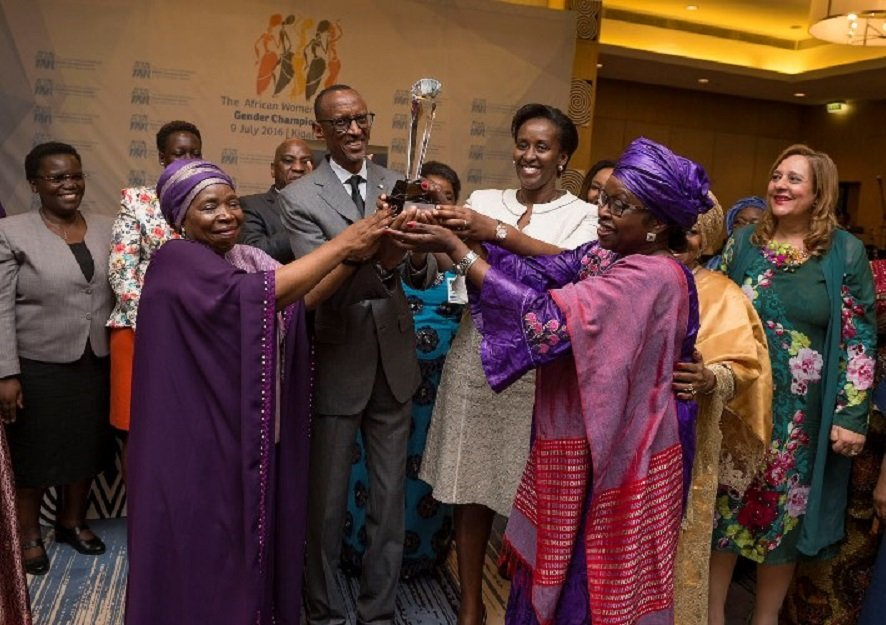
Rwandan president Paul Kagame awarded the Gender Champion Award in 2016 alongside Nkosazana Dlamini Zuma, the former Chairperson of the African Union Commission, by the African Women Movement.
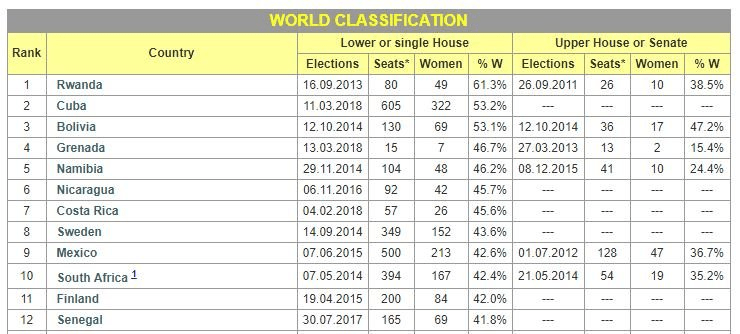
Rwanda’s parliament has improved its ratio of women legislators which is the highest in the world. The East African country recently elected 58 women legislators out of the 80 members of parliament. This is an improvement on the previous parliament’s 49 women representatives.
NEWS UPDATE: Final tally shows number of women MPs in Rwanda parliament up by 2 points to 66%. The 80 member House now has 53 women lawmakers pic.twitter.com/jOdtfUzPng
The data in the table below has been compiled by the Inter-Parliamentary Union on the basis of information provided by National Parliaments by 1st June 2018.
Rwanda also ranks highest in labour participation among women and women make up more than half of Kagame’s cabinet, but the statistics are not the true reflection of the situation in the country which has been led by Paul Kagame who has been in office for 18 years.
Human rights, legal inequality and access to justice have plagued the country’s positive record on women’s rights and have exposed the glass ceiling that is just above the parliamentary level.
Women have had slim chances of getting to the top in Rwanda’s political hierarchy as the only woman to ever rise to the topmost position was Agathe Uwilingiyimana who was Prime Minister of Rwanda in 1993.
She was assassinated on April 7, 1994, by the presidential guard 14 hours after the assassination of President Habyarimana which commenced the genocide.
Two decades later, two Rwandan women have attempted to run against President Paul Kagame but ended up in jail for various reasons which are politically motivated.
Read more about them below.
Victoire Ingabire Umuhoza
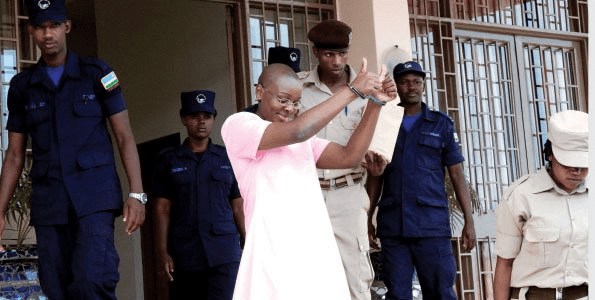
Born in October 1968, Victoire Ingabire Umuhoza is currently serving a 15-year prison sentence at the Kigali Central Prison on charges of terrorism and threatening national security.
She was arrested in 2010 after she returned to her country following 16 years in exile to contest as a candidate against Paul Kagame in Rwanda’s August 2010 presidential election.
Umuhoza was the leader of the coalition of exiled opposition political groups, Unified Democratic Forces (UDF), and she resigned her work as an official of an international accounting firm in the Netherlands, where she was in charge of its accounting departments in 25 branches in Europe, Asia and Africa, to help rebuild her country.
She has worked for her party since 1997 from her base in the Netherlands and was key in the creation of the coalition to rival the dominant Rwandan Patriotic Front (RPF) party of Paul Kagame which has no opposition in the country and was stifling dissent and persecuting opposition members.
Umuhoza was held under house arrest only three months after arriving in the country. She formed the Permanent Consultative Council of Opposition Parties with two other opposition leaders in Rwanda to strengthen the democratic process.
She became a threat to Kagame’s government since the first day of her arrival when she gave a speech at the Gisozi Genocide Memorial Centre to honour the victims of the genocide. Umuhoza called for the acknowledgement of Hutus who also died during the genocide and justice for all to bring about reconciliation.
This speech was used as evidence for the charge of genocide revisionism which was levelled against her in court after her arrest. She was placed under house arrest in April 2010 and then detained in October with four alleged co-conspirators accused of “forming an armed group with the aim of destabilising the country, complicity to acts of terrorism, conspiracy against the government by use of war and terrorism, inciting the masses to revolt against the government, genocide ideology and provoking divisionism.”
After a long court battle including intimidation of witnesses and allegations of bribery attempts by the Rwandan intelligence agencies to rebels to testify against Umuhoza, Victoire Ingabire Umuhoza boycotted the court proceedings.
In 2012 after four postponements of the verdict and the prosecution’s request for the maximum life sentence, Umuhoza was sentenced to eight years by the Kigali High Court for “conspiracy against the country through terrorism and war” and “genocide denial”.
A year later, the Supreme Court has upheld the conviction and increased her jail term to 15 years. Victoire Ingabire Umuhoza is married and a mother of three. She was nominated with two other Rwandan political figures in prison for the European Parliament’s Sakharov Prize for Freedom of Thought in 2012.
Diane Shima Rwigara
Diane Shima Rwigara is a 36-year-old women’s rights activist and entrepreneur who is currently behind bars in Rwanda for alleged incitement to insurrection.
Her woes started after expressing interest in challenging Paul Kagame in the August 2017 presidential election as an independent candidate.
The daughter of businessman Assinapol Rwigara, who was pivotal in the ruling Rwandan Patriotic Front, distanced herself from the party after her father’s death in 2015 in a road accident which she claimed was an assassination.
She gained a lot of support on social media after the scandal including condemnation of the act of online shaming. After a few days of silence, she bounced back to continue her campaign.
After picking up forms to file her candidacy, she was hit with another blow as the National Electoral Commission disqualified her with other opposition candidates for errors in application forms and inadequate signatures from the districts. Rwigara described the disqualification as a political influence.
She launched an activist group called the People Salvation Movement to challenge the Kagame regime to ensure human rights. This was immediately followed by a raid of her family’s house by the police who said they were investigating them for forgery and tax evasion.
Rwigara and her family faced series of arrests without specified charges. Separate charges including inciting insurrection, tax evasion, offences against state security, use of counterfeited documents among others were levelled against Diane, her sister Anne and mother Adeline.
She remains in prison as her trial is ongoing. Meanwhile, her family’s assets and stock of their tobacco company have been auctioned off by the country’s revenue authority which said it was recovering unpaid taxes.
The family has filed court cases against the confiscation of its assets and the sale of their stock at a much lower rate.
Civil society and rights organisations have described the arrests and intimidation as politically motivated. Amnesty International has called on the Rwandan judiciary to ensure that Diane Rwigara’s trial does not become another means to persecute government critics.
This article written by Ismail Akwei was first published on face2faceafrica.com
However, only one country in the continent wants none of the Chinese support and has refused to adhere to the terms of China to benefit from the development drive. This country is eSwatini, the only absolute monarchy in the world that was formerly known as Swaziland.
King Mswati III visits Taiwan
Until recently, eSwatini, Sao Tome and Principe and Burkina Faso were the only African countries that recognized China’s bitter allies Taiwan and were punished with aid restrictions. China succeeded in ensuring the closure of all Taiwanese embassies in all African countries they had succeeded in wooing.
Sao Tome and Principe and Burkina Faso fell for the millions of dollars China was offering while eSwatini preferred to hold on to Taiwan which is considered as a breakaway region by China. The Taiwanese government provides eSwatini with aid and economic assistance.
Burkina Faso re-established ties with China after ending relations with Taiwan in early 2018
Meanwhile, China has assisted the rest of the continent with $60 billion in 2015 and presently, another $60 billion for Africa and a clean-up of the debt maturing by this year of its LDCs, highly indebted, landlocked and Small Islands States.
These form part of the eight new initiatives announced at the Forum for Africa-China Cooperation, FOCAC, in Beijing on September 3-4. China also launched an initiative to promote non-resources-based China imports from Africa and a $5 billion special fund to accelerate such efforts.
China and Taiwan separated in 1949 after the Communist victory in a civil war that saw the Nationalists flee to the island. The two sides have never united ever since despite back and forth diplomatic battles.
China has ensured that any country that establishes ties with Taiwan will be sanctioned diplomatically.
This article written by Ismail Akwei was first published on face2faceafrica.com
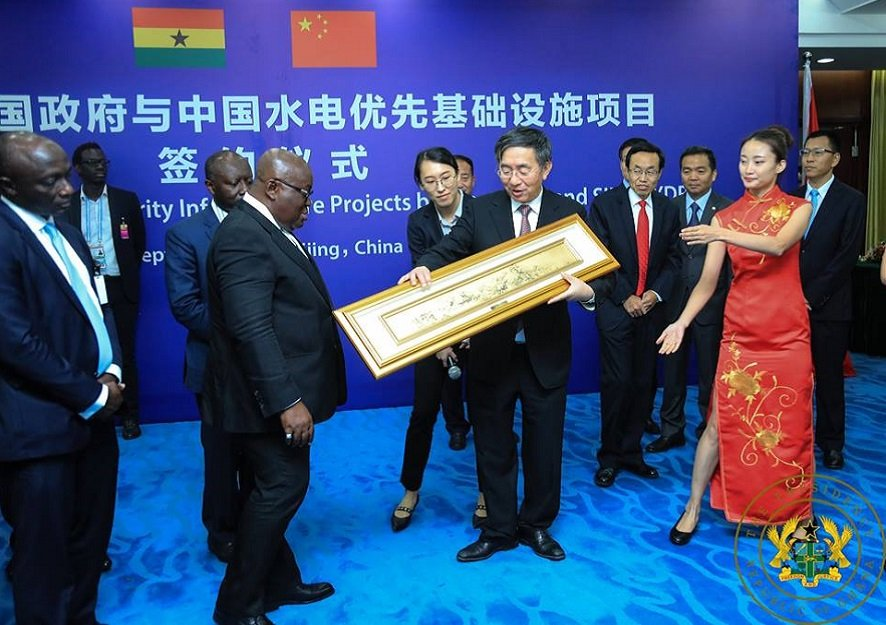
Ghana’s president after signing Chinese development agreement in Beijing ahead of China-Africa Summit
Last week was a busy moment for African heads of state and government as they received representatives of former colonial masters Britain and Germany who wanted to boost trade and diplomatic presence in the continent.
Their visit raised a lot of questions regarding the kind of cooperation the Western countries were interested in especially when they were offering funds and introducing businesses while their economies are struggling.
British Prime Minister Theresa May visited South Africa, Nigeria and Kenya on her three-day Africa tour and announced £4 billion ($5.1 billion) of extra British support for African economies in order to overtake the U.S. to become the continent’s biggest investor by 2022.
German Chancellor Angela Merkel was also in Senegal, Ghana and Nigeria at the same time to not only discuss about the illegal West African immigrants on their deportation list, but to bring German businesses to the continent. Car maker Volkswagen managed to secure deals with Ghana and Nigeria to build assembling plants in the countries.
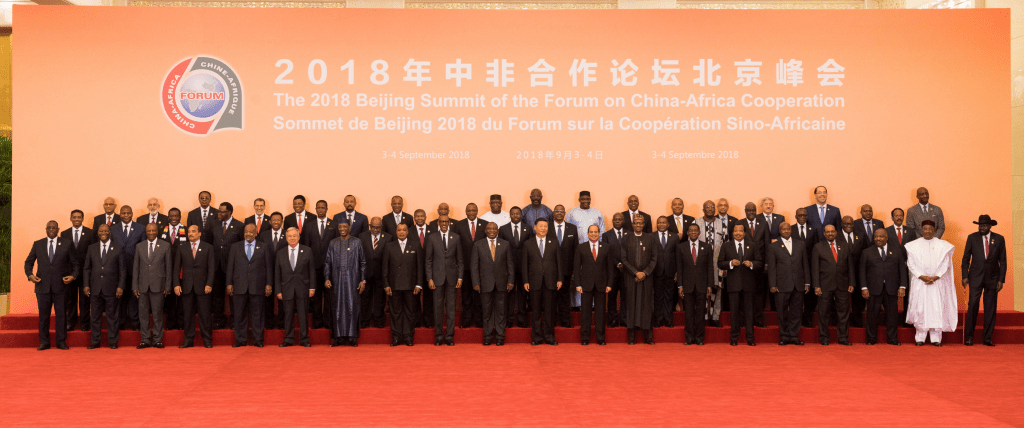
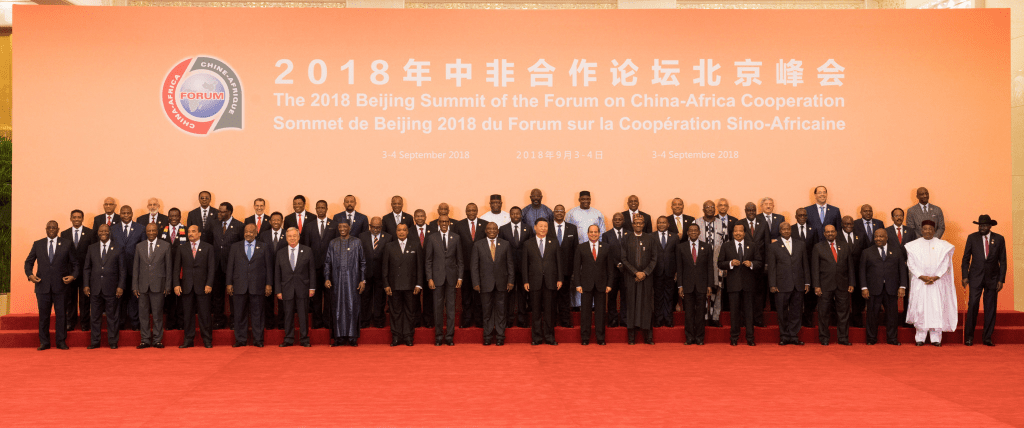
The real winner in these partnerships is China which has invited leaders of the entire continent to attend the two-day Forum for Africa-China Cooperation, FOCAC, in Beijing on September 3-4, 2018. This summit follows the immediate exit of Britain and Germany from Africa.
All but six of the over 40 African leaders and heads of state and government attended the 3rd Summit chaired by the Communist leader Xi Jinping to definitely tighten China’s grip over Africa and to deepen Africa’s dependency on China.
The absent leaders, according to checks by Africanews, are John Magufuli of Tanzania who is represented by Prime Minister; Pierre Nkurunziza of Burundi who is represented by his second vice-president; Joseph Kabila of the Democratic Republic of Congo who is represented by his Prime Minister; Isaias Afwerki of Eritrea, Abdul Aziz Bouteflika of Algeria and King Mswati of eSwatini (formerly Swaziland) who has no representation at all at the summit.
“China and Africa: Toward an Even Stronger Community with a Shared Future through Win-Win Cooperation,” read the theme of the summit which has resulted in the signing of dozens of agreements by African leaders with China.
Xi Jinping has announced eight new initiatives, an additional $60 billion for Africa and a clean-up of the debt maturing by this year of its LDCs, highly indebted, landlocked and Small Islands States. This means loans are clearing loans and the cycle continues.
Chinese President Xi Jinping pledges to invest $60 billion in Africa #FOCAC2018
-$15 billion in aid -$20 billion credit line -$10 billion development financing -$5 billion for imports from Africa -$10 billion investments from Chinese companies#FOCACpic.twitter.com/HxYAgWXgra
Ghana and a dozen others signed agreements before the start of the summit for China to build more roads, develop the aviation sector, improve healthcare delivery and many more projects in their countries.
Ghana, China Sign Eight Co-Operation Agreements, MoUs
Ghana and China have signed 8 Co-operation Agreements and MoUs, in different sectors of their respective economies, aimed at deepening the ties of co-operation and the bonds of friendship that exist between the two countries. pic.twitter.com/7BWSy98n4c
Meanwhile, Africa’s win is an initiative launched by the Chinese premier to promote non-resources-based China imports from Africa and a $5 billion special fund to accelerate such efforts. Clearly, Africa cannot even facilitate its exportation of non-resource-based products. China is leading everything.
With all these developments, Africa Beyond Aid crusader Paul Kagame, President of Rwanda, maintains that “Africa is not a zero sum game. Our relationship with China does not come at expense of any other.”
South African president Cyril Ramaphosa is of the view that as China expands its grip of the continent, more local partnerships need to be encouraged between Chinese and African entrepreneurs.
President #Ramaphosa: It is through platforms like FOCAC that we should work to balance the structure of trade between Africa and China. As we look to expand Chinese investment in Africa, we need to encourage more local partnerships between Chinese and African entrepreneurs.
Rita Marley (seated), wife of late Reggae legend Bob Marley surrounded by other diasporans at an event in Accra. She is the first diasporan to be granted citizenship in Ghana after her emigration.
Africa is the cradle of all mankind and science has proven that every human genetically has DNA which can be traced back to the continent. Africa has a population of 1.2 billion while the rest of the world has a black population of a little above that number.
If you are black, then you are definitely of African descent and only two African countries have made attempts to help people of African descent relocate to the continent where they originate.
Besides the black people who naturally left the continent to Australia, the Americas, Asia and Europe in the pre-medieval era, 12.5 million Africans were shipped to North America, the Caribbean and South America by European slave traders between 1525 and 1866. Only about 10.7 million survived the dreadful journey across the Atlantic.
Freedom, enlightenment and modernity stoked the passion of some people of African descent to return to the continent at a period when Africa was languishing under colonial rule.
There were also ex-slave repatriations funded by the colonists and also individuals of African descent who single-handedly found their way back to the continent after witnessing torturous experiences black people faced in Europe and beyond despite the abolition of the slave trade.
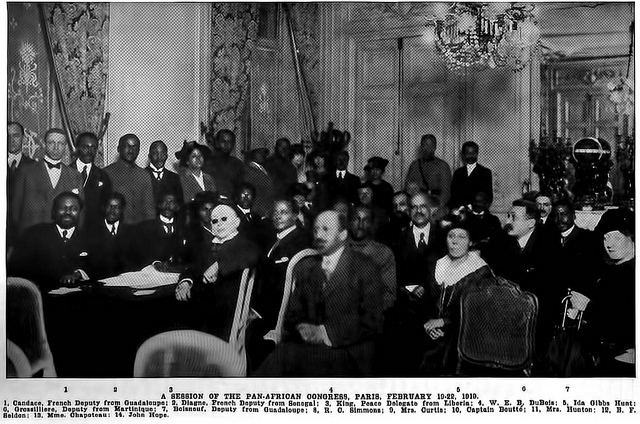
As Africa was facing harsh treatment under colonialism after Britain had banned the slave trade in 1807 – the United States in 1865 and Brazil in 1888 – black intellectuals came together to form associations including the Pan-African Congress and the Pan-African Federation to demand the end of imperialism in Africa. This was the era of Pan-Africanism.
Pan-African Congress in Paris, 1919
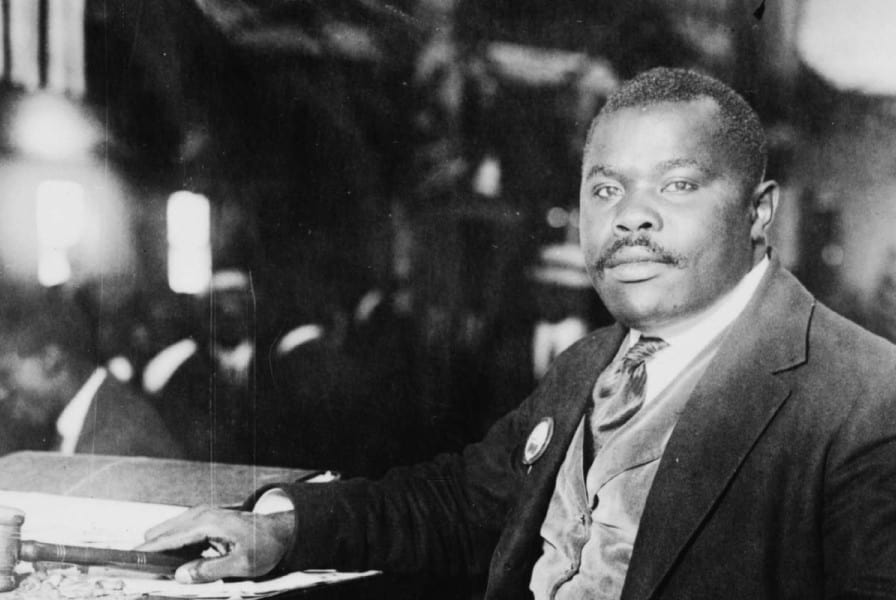
Pan-Africanism gave birth to the Back-to-Africa movement of the late 19th century which founded Sierra Leone and Liberia. Marcus Garvey also championed the return of black people to the continent and the exit of European colonizers for the Africans to manage their own affairs. This ideology was supported by the early followers of the Rastafari Movement who believed that Marcus Garvey was the John the Baptist of the time and Emperor Haile Selassie of Ethiopia was the Messiah.
However, there was little response from Africans in the continent on the Back-to-Africa movement as their struggle was focused on gaining independence. In 1913, a merchant and pioneer pan-Africanist from the Gold Coast (Ghana), Alfred Charles Sam, personally started a campaign to resettle African Americans in their “ancestral home” in freedom.
Sam purchased the former German ship Curityba and renamed it S.S. Liberia to embark on a voyage back to Ghana to settle at Akim. He initially embarked on the first voyage with 60 African Americans who sold all their property to join him in the “promised land”. They made it to Saltpond but were denied ownership of the land Sam had promised at Akim.
After physical and financial hardships due to restrictions, some of the settlers returned to Oklahoma where they came from while others went to other African countries including Liberia.
In the 21st century, the conversation is mainly focused on emigration from Africa to Europe and the United States but not on the other way around.
The African Union describes the African Diaspora as composed of “people of African origin living outside of the continent, irrespective of their citizenship and nationality, and who are willing to contribute to the development of the continent and the building of the African Union.”
But, how can a person of African descent contribute to the development of the continent if he does not have a “home” and a feeling of belonging in Africa?
Only two African countries have made an active attempt to offer their widow’s mite to the people of African descent who decide to return home.
The first gesture was from Ethiopian Emperor Haile Selassie I who offered 500 acres of land at Shashamene (150 miles south of Addis Ababa) to black people from the West for supporting him in his struggle with Italy during its invasion of Ethiopia in 1935.
Forces of the Italian dictator Benito Mussolini forced Selassie into exile in Britain but were later defeated and kicked out of the region by British forces in 1943.
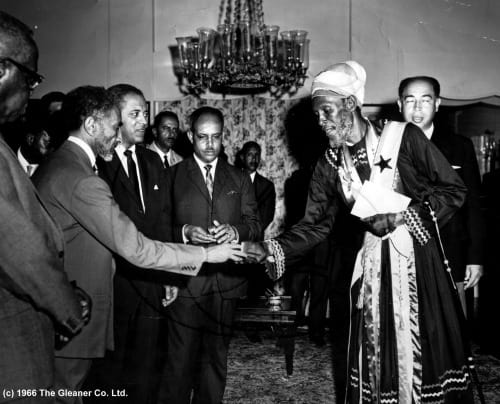
Selassie, who is revered as a god by the Rastafari movement, returned to his throne and offered the land in 1955. African-American Jews settled in first but moved on to Liberia and Israel. In 1963, Rastafarians started emigrating to the “promised land” and their number swelled in 1966 after Selassie’s visit to Jamaica.
The overthrow of Haile Selassie in 1974 ended the movement as the coup makers took over all lands including Shashamene and many settlers fled the country. Today, many of the returnees do not feel welcome in the country as they are still regarded as foreigners.
Many had already given up their Caribbean identity and could not get Ethiopian identity, thereby leaving them stateless. After 67 years of petitioning to be granted citizenship status, the Ethiopian government in 2017 promised to offer the nearly a thousand settlers official identity.
The foreign ministry said at the time that Rastafarians in the country and foreigners who have contributed to its development including Ethiopian Jews will be given identity cards to be able to reside and enjoy some benefits like citizens.
It added that with the identity cards, they can live in Ethiopia without residence permits and can enter the country without visas. However, they cannot vote in elections and enlist in the security agencies.
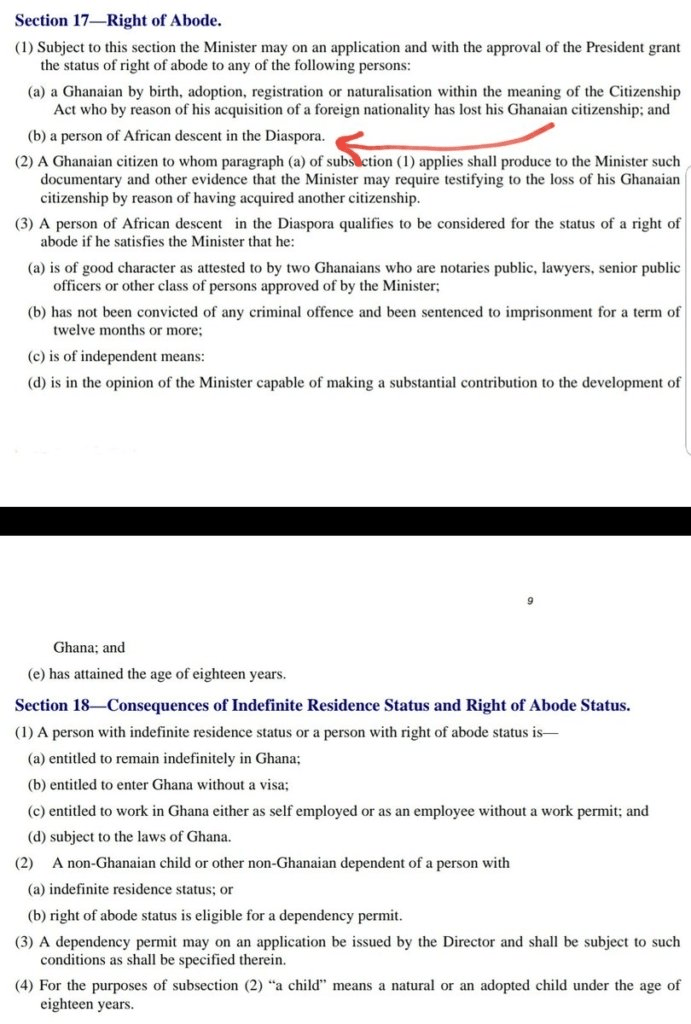
It is a different story in Ghana, the only country in the 21st century that has legally offered to resettle people of African descent in Africa. In the year 2000, Ghana became the first African country to officially open its doors to people of African descent from all over the world.
This was followed by the launch of the Diaspora Affairs Bureau under the foreign affairs ministry in 2014 to manage the migration and engage the diaspora to provide a sustainable link with various government agencies to achieve development and investment goals.
As at 2014, over 3,000 African-Americans and people of Caribbean descent are estimated to be living in Ghana. The Diaspora Affairs Bureau has expedited the acquisition of the permanent residency which was earlier delayed by bureaucratic processes. It took some applicants years to get their official documentation when it was supposed to take six months.
Many resorted to renewable resident permits and marriages with Ghanaians to stay and work fruitfully in the country. Rita Marley, the wife of reggae legend Bob Marley, was the first person to be granted the indefinite stay in Ghana in 2014, 14 years after the law was passed.
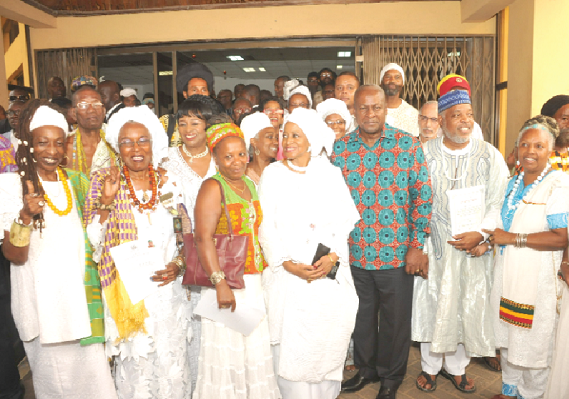
Former Ghanaian President John Mahama with some Afro-Carribean people who have been granted citizenship in December 2016
Ghana was home to pan-Africanists like George Padmore, Maya Angelou, W. E. B. Du Bois, Pauli Murray among others who emigrated after the country’s independence in 1957 after establishing a friendship with the first president Kwame Nkrumah who himself had studied in the United States.
Why can’t other African countries emulate this gesture?
This article written by Ismail Akwei was first published on face2faceafrica.com








 Ismail Akwei