This Ghanaian pastor was only fined $962 for whipping ‘fornicating’ church members

Ghanaian Pastor Daniel Obinim during a deliverance service

Two years ago, controversial Ghanaian pastor Daniel Obinim was in the news for publicly flogging a teenage couple with his black leather belt over “fornication” accusations during a church service broadcast live on TV.

The assault gained a lot of attention after a video of the August 2016 incident circulated widely on social media showing the Bishop of the International God’s Way Church, whipping the teenagers he claimed he had adopted while insulting them in front of a cheering congregation.

Obinim claimed that he had a revelation from God that the teenagers had engaged in premarital sex which resulted in a pregnancy that was aborted, and that the Holy Spirit directed him to chastise them in public, reports local media Daily Graphic.

In the video, he called the couple “stupid” and questioned the financial status of the 16-year-old boy who he said was a student. “You are foolish. You are now learning a trade, you joined barely three months now, you are foolish. I will hit you with the hook,” he told the visibly frightened 14-year-old girl who he said was learning to be a hairdresser and make-up artist.

In the video, he called the couple “stupid” and questioned the financial status of the 16-year-old boy who he said was a student. “You are foolish. You are now learning a trade, you joined barely three months now, you are foolish. I will hit you with the hook,” he told the visibly frightened 14-year-old girl who he said was learning to be a hairdresser and make-up artist.

Obinim and his two accomplices had initially pleaded not guilty to a physical abuse charge abetment of crime. They were reportedly fined after changing their plea to guilty.

The three were made to sign a bond to be of good behaviour for 12 months or otherwise serve an additional three months in jail.

Daniel Obinim has been in the news several times for the wrong reasons including having sex with the wife of a junior pastor, vandalism, stomping the stomach of a seemingly pregnant woman during deliverance service, and claims that he is an Angel and he flies to heaven to see Jesus.

He recently claimed to have met the biblical Adam and Eve after an introduction by God in the spiritual realm. He has thousands of followers who attend his church which has over a dozen branches across the country.

Obinim is on the long list of African pastors who are living lavishly and claim to heal the sick and enrich the poor while taking money from these same people for God’s work.

Recently, South African pastor, Prophet Rufus Phala, made his congregation drink Jik bleach and six people died as a result. In 2016, he made the congregation drink Dettol creating a public uproar.

There is also Pastor Lesego Daniel in Pretoria, South Africa, who instructed members of his congregation to drink petrol while Pastor Penuel Mnguni forced his church members to eat grass, swallow snakes and even strip naked.

There is also Pastor Lesego Daniel in Pretoria, South Africa, who instructed members of his congregation to drink petrol while Pastor Penuel Mnguni forced his church members to eat grass, swallow snakes and even strip naked.

This article written by Ismail Akwei was first published on face2faceafrica.com

To be president in poor Benin you have to be $450,000 richer, new law says so

Patrice Talon during his swearing in as president

The government of Benin has incurred the wrath of its citizens after it increased the fee to contest as a presidential candidate in the 2020 election by 1,500 per cent to 250 million CFA francs ($450,000).

With almost 50 per cent of its population living below the poverty line, Benin increased the fee from the $26,000 required ahead of its 2016 election which was won by wealthy businessman Patrice Talon.

Benin president Patrice Talon

Talon’s government also increased the fees for candidates interested in the legislative elections from $14,000 to $440,000. It will be enforced if the country’s Constitutional Court approves the law.

The law has received massive condemnation from political parties, civil society groups and the public who accuse the president of formulating laws to favour the rich and privileged.

“By brutally and clumsily excluding anyone who is young, poor or disadvantaged, the government and its allies in parliament have this time gone too far,” says former Beninese president Nicephore Soglo who told AFP that it was a move towards authoritarian rule.

Soglo is the honorary president of the opposition party Renaissance Benin and his party will be affected if the law is passed as they will be subjected to pay a similar fee to take part in parliamentary elections in 2020.

Talon has recently adopted controversial laws in the tiny West African country that have been met with protests, strikes and mass condemnation.

There were protests earlier this month after the parliament adopted a law limiting the rights of both public and private sector workers to go on strike to a maximum of 10 days per year.

Last week, the country also repealed a law that will tax its citizens 5 CFA francs ($0.008) per megabyte on the usage of social media apps, and another 5% levy on texting and calls. The internet and social media tax was described by civil society as a move to silence critics.

Meanwhile, neighbouring Nigeria is also increasing the stakes to participate in the upcoming elections despite reducing the age for candidates to 35.

The ruling All People’s Party (APC) is demanding $125,000, $63,000, $19,460 and $ 10,570 from presidential, gubernatorial, senatorial and member of assembly aspirants respectively. For the opposition Peoples Democratic Party (PDP), the same positions go for $33,350, $16,680, $6,950 and $1,670 respectively.

Leadership in Africa has indeed been reserved for the rich and affluent.

This article written by Ismail Akwei was first published on face2faceafrica.com
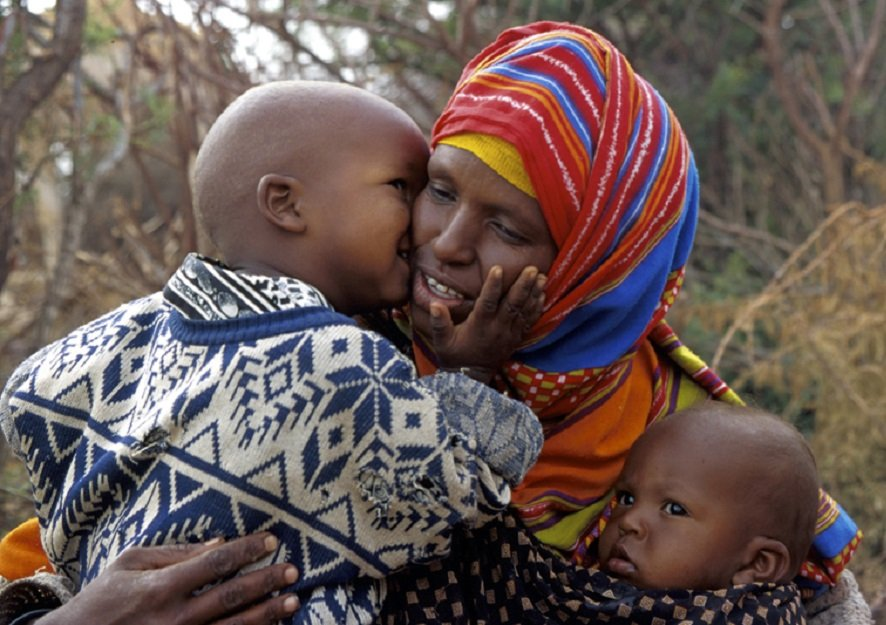
The painful ordeal of the Bantu people in Somalia facing discrimination due to their dark skin

Somali Bantu woman with her children — Photo: UNICEF

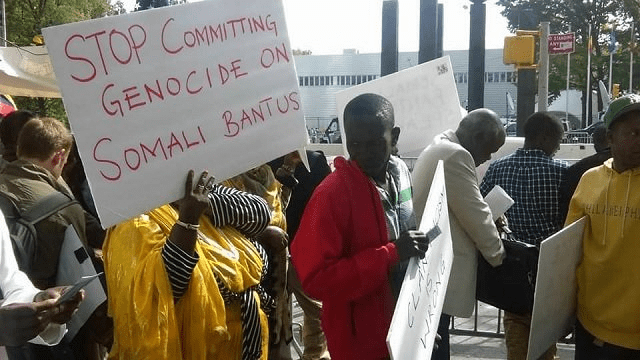
It was a rude awakening when a dark-skinned Somali Member of Parliament stood before the federal legislature to pour out his frustration on how he and his tribespeople are being treated in Somalia due to the colour of their skin.

“I arrived at the Mogadishu airport with my diplomatic passport. The immigration officers scrutinised me and talked to each other saying this Ugandan has a Somali diplomatic passport. The officer orders I pay $50.

“They were addressing me in English but I ignored them. Finally, I answered them in Somali and explained who I was … Majority of Somalis are ignorant of the existence of the Somali Bantu community who are nationals of this country,” says MP Mohamed Nuur who narrated his ordeal as a black man before the Somali Parliament on Monday.

In Europe, Asia and America, this act is called racism as white people judge others based on the colour of their skin. It is despicable to come to Africa – which is a continent of black people – for a light-skinned African to treat a dark-skinned fellow like an outcast.

Discrimination is a mild description of what the Bantu ethnic group is facing in Somalia where they’ve been for hundreds of years. Somali societies disapprove of marriages between Bantu tribespeople and people from other clans. The result of this was the killing of mechanic Ahmed Mukhtar Salat who was lynched in Mogadishu by the in-laws of his nephew protesting their daughter’s marriage to a Bantu.

Salat was torched to death by a mob at his garage while the couple were on their honeymoon after the wedding, reports local Somali media Radio Dalsan. The attack sparked a protest against marginalisation and discrimination of the Somali Bantu.

“If we can marry white women in America I don’t understand why our brothers here in Somalia don’t allow us to marry from other clans … Discrimination thrives in Somalia. Let’s be civilised and let’s not allow discrimination in our country,” Nuur added in his speech to the Somali Parliament.

The Bantu population in Somalia is mostly found between the Juba and Shabelle rivers in the south of the country that is regarded as Somalia’s food basket. The Bantus are farmers and they locally call themselves “jareerwayne”.

Unlike the ethnic Somalis who have a light skin, long noses and straight hair, the Bantus have dark skin, woolly hair and broad noses like most people in other parts of Africa.

The Bantus historically settled in Somalia as merchants, mercenaries, indentured servants, and slaves. The latter occurred during the Arab slave trade when they were captured and sold from Southeast Africa into slavery in Somalia.

They have always faced marginalization and their descendants in the 21st century are not any better as many have fled the country since the Somali civil war in the 1980s. The Bantus form part of the largest refugees camped at the Dadaab and Kakuma refugee settlements in Kenya under the supervision of the UNHCR.

Kakuma Refugee Camp

Between 2003 and 2007, the United States resettled around 13,000 Bantus in cities across the country and many continue to live in states like Utah, Colorado, Texas and Arizona among many other Somali settlements. Some Bantus integrated into Kenya, Tanzania, and countries in Europe and America.

Many Bantus have resettled in Tanzania and Mozambique, the two countries they regard as their ancestral home where their forefathers were taken as slaves. The United States had repatriated some Bantus to Tanzania where they were given lands and granted citizenship.

Meanwhile, several Bantus in Europe and Australia still dream of returning to Somalia to reclaim their properties which they lost to the war. They still call Somalia home despite the marginalization which is seeing no improvement. These Bantus organise protests and appeal to Western governments to come to the aid of their tribespeople in Somalia.

This article written by Ismail Akwei was first published on face2faceafrica.com
Benin becomes first African country to listen to its citizens and cancel internet tax

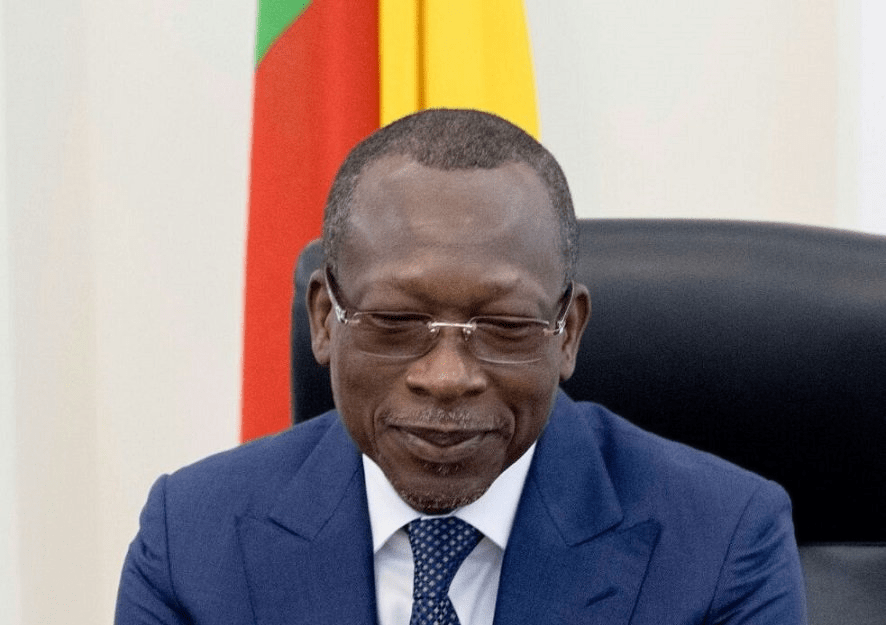
Benin president Patrice Talon

West African country Benin has shown respect to the demands of its citizens who fought against a planned social media and internet tax that was imposed via a new law in late August.

The government planned to tax its citizens 5 CFA francs ($0.008) per megabyte on the usage of social media apps, and another 5% levy on texting and calls. A decision which civil society organisations have described as a move to silence critics.

Over 7,000 people signed a petition calling for the suspension of the levy which would not favour the mass poor population of a little above 10.5 million and a minimum wage of about 40,000 CFA francs ($70.56) per month. Thousands of young Beninese citizens used hashtags to protest against the tax.

The Beninese president Patrice Talon, in a tweet, announced the repeal of the law on social media and internet tax “following a meeting the government ministers had with telecommunication companies”.

Digital rights advocates, Internet Sans Frontières (Internet Without Borders), attributed the “victory” to the activism and strength of the thousands of young Beninese citizens who engaged the government and enforced democracy in their country.

“Internet Without Borders welcomes this victory of digital citizenship in Benin. The mobilization online, around the Hashtag #TaxePamesMo (Don’t Tax My MegaBytes), showed to the world the anger of netizens in the country. This anger and indignation enabled them to denounce the tax and to enter into a dialogue with the authorities, which fortunately led to its cancellation. This case also shows the strength of the young Beninese democracy. The annulment of the social media tax is an important precedent for digital rights and freedoms in West Africa,” says Julie Owono, the Executive Director of Internet Without Borders.

This decision makes Benin the first African country to repeal a law on the internet tax after it joined the likes of Zambia and Uganda to impose taxes on internet usage despite a heavy backlash.

Kenya recently announced plans to impose taxes on the internet as part of the amendments of the country’s Finance Act which proposes a 15 per cent tax on internet services.

The amendment also includes an increased tax on telephone services and all money transfer services from the previous 10 per cent to 20 per cent. The tax will affect money transfer via mobile, banks, agencies and other financial service providers.

In Zambia, the government collects the taxes through mobile phone companies and internet service providers at a daily rate of 30 ngwees (3 cents) per day, irrespective of how many internet calls are made.

The whole internet tax craze started in Uganda where the government ignored protests and imposed a mandatory 200 shilling daily levy (less than a dollar) for WhatsApp users while mobile money transactions also attracted a one per cent levy on the total value of each transaction.

In a bid to control what he called gossip and to rake in more revenue to the state, Ugandan president Yoweri Museveni announced the taxes in April and it was approved by the parliament in May.

It is expected to raise between $108,000,000 (Sh400 billion) and $270,000,000 (Sh1.4 trillion) from social media users annually, the government said.

Ugandans, have, however, expressed disgust at the development, saying it infringes on individual freedoms.

Others are also wondering how social media companies that do business in Uganda will be taxed since internet access is not based solely on the activation of data bundles through the purchase of airtime from telecoms.

For some lawmakers, instead of taxing social media, the president must pay attention to the fight against corruption in government.

This article written by Ismail Akwei was first published on face2faceafrica.com
These 10 African countries are more peaceful than the UK and U.S.

Night view of the capital of Mauritius, Port Louis — Photo: voilahotel.mu

Every year, since 2007, the Institute for Economics and Peace releases an index of the most peaceful countries in the world called the Global Peace Index (GPI), the world’s leading measure of global peacefulness.

The GPI presents the most comprehensive data-driven analysis of trends in peace, its economic value, and how to develop peaceful societies.

It uses 23 indicators and measures the state of peace using three thematic domains: the level of Societal Safety and Security; the extent of Ongoing Domestic and International Conflict; and the degree of Militarisation.

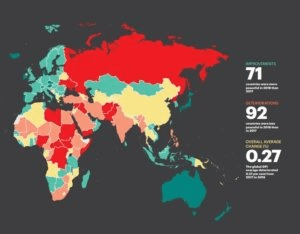
The 2018 Global Peace Index released in June found that the global level of peace has deteriorated for the fourth successive year as only 71 countries improved out of 163 countries.

Iceland maintained its top spot since 2008 as the most peaceful country in the world followed by New Zealand, Austria, Portugal and Denmark respectively. At the bottom is Syria which maintained its least peaceful country in the world status since 2013. It is followed by Afghanistan, South Sudan, Iraq and Somalia respectively.

Meanwhile, the top ten most peaceful countries in the Sub-Saharan African region were found to be more peaceful than the about a third of Europe including the United Kingdom; and the United States of America.

The UK’s peace deteriorated over the year ranking them at 57 globally while the United States ranked at 121 in the world.

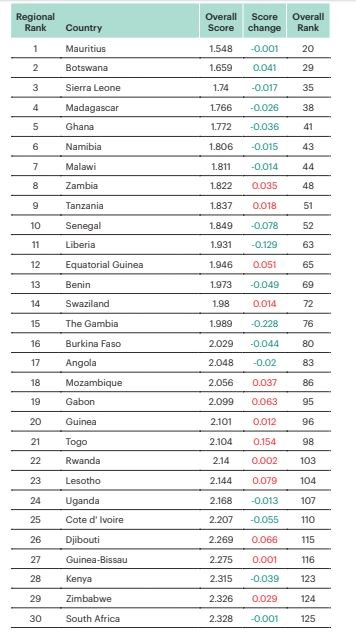
Mauritius maintained its top position in Africa as the most peaceful in the continent while ranking 20th globally. The island nation was followed by Botswana (29), Sierra Leone (35), Madagascar (38), Ghana (41), Namibia (43), Malawi (44), Zambia (48), Tanzania (51), Senegal (52).

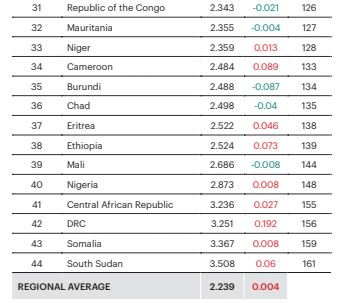
Half of the 44 Sub-Saharan African countries in the index ranked above 100 globally. Below is the full list of African countries and the level of peace they enjoy.

This article written by Ismail Akwei was first published on face2faceafica.com